Visit any antique power show and you are sure to find row after row of pristine green and yellow tractors gleaming in sunlight. You might wonder if you had somehow wandered onto the lot of a John Deere dealership. While I can appreciate the desire of the owners to protect and preserve their new toy, the sense of history is gone, covered over by a thick coat of new paint.
Monday, March 1, 2021
John Deere Model A
Monday, February 1, 2021
Pattin Brothers Oil Field Engine
What did Mobey Dick, John D. Rockefeller and the Pattin brothers have in common? They all benefited from the Pennsylvania oil boom.
The oil had been there, almost since time began. It was so close to the surface that in some places around Titusville it oozed out onto the ground. The Native Americans had collected it for centuries to use as an insect repellent and ointment. Beyond that it had little value. The early European settlers regarded it as a nuisance because the soil it contaminated was no good for growing crops but the mid nineteenth century would see a drastic change.
In 1849 if you stayed up after sunset you lit a candle or a lamp that burned whale oil. The demand was huge and fleets of whaling ships roamed the seas. As many as 15,000 right whales were being turned into barrels of oil in a single year. Whale oil was the world’s illuminant of choice but it was also expensive. A Pennsylvania resident by the name of Samuel Kier began to experiment with ways to refine the crude oil that was so abundant in the area into a usable fuel. In 1850 he formed a company to market his improved lighting oil as “Carbon Oil.” Kier’s business met with success so he soon had many imitators.
Friday, January 1, 2021
Gainesville-Midland Number 209
I was passing through Gainesville, Georgia on my way to the Steam Expo. when I spotted this engine. Steam locomotives are my favorite so it was time to take a stretch break. After walking all around the engine I realized that I hadn’t seen any signs or information displays. Maybe I had overlooked something so I walked around again looking for any signs I might have missed. No doubt this time, there just weren’t any, I thought this was odd since the town had gone to considerable expense to create a nice display. It was the beginning of a pattern that would repeat itself.
As if to make sure that the curious were denied all information, someone had removed the identification plates from both sides of the boiler. Was this the work of a souvenir hunter? Maybe, but I doubt it. Those plates are usually attached to the boiler with some fairly substantial rivets. At this point I had some photos but no info about what it was.
Time passed. When I got around to researching this post I emailed the city of Gainesville to see what light they could shed on the history of No. 209. The contact person replied that she would ask around and get back to me. In the meantime I might want to contact the local historical society, I had planned on doing that anyway so that was my next move. I’m still waiting to hear from the city. I guess they’re content to use it as a holiday ornament and let it go at that.
The people at the historical society replied by sending me a pdf of an article that had appeared in the local newspaper: “Uncovering the Past, Gainesville-Midland # 209” by David French. In it Mr. French refers to a book titled: The Gainesville-Midland and her Sister Short Lines by Douglas Van Veelen. In his book, Van Veelen asserts that # 209 was built by Baldwin in March of 1930. Mr French writes that no sources were referenced and that Van Veelen offered no explanation of how he came by this knowledge but he accepts it at face value.
There are a number of reasons that I question Van Veelen’s assertion about the origin of this machine. First and foremost is the fact that it looks like one of the Russian decapods designed and constructed in 1917 under the supervision of A.I. Lipetz, the head of the locomotive division of the Russian State Railway. You can compare this engine to one of the pictures a search for Russian Decapods will produce and judge for yourself. The boiler mounted high above the drivers and the location of the firebox on #209 are distinctly Russian. Baldwin did build 2-10-0’s for American railroads, but they looked similar to most other engines operated in this country.
The Decapod design filled a very narrow niche market because they did one thing very well, pulling heavy loads on steep grades at low speeds. The Pennsylvania Railroad was one of the few in the USA that operated a large fleet of decapods. All told they used 598 2-10-0’s on their Allegheny Mountain routes where the design excelled for slow drag service. The Gainesville Midland on the other hand, was a short line that ran from Gainesville to Athens Ga. an area that isn’t exactly mountain country.
The Russians placed the largest orders for 2-10-0’s by far that American builders ever received. In 1917 the Czar’s government ordered 1057 of which 857 were shipped before the Bolsheviks stole the country. During World War ll another 2200 were built ( and no doubt paid for as part of lend lease, with American taxpayer dollars ) for our wonderful allies, the Soviets. With these two exceptions, orders were few and far between. American railroaders just preferred the 2-8-0 design. It’s those 200 that were left in country during the First World War that are of interest here.
When the United States entered the war, the nation’s railroads were effectively nationalized and the 200 decapods were drafted into the service of the United States Railroad Administration. Those 200 engines would be distributed to railroads across the country and most were put into service on short branch lines. Seaboard assigned it’s allotment to the Hamlet / Raleigh area where they served until the early 50’s when a group was transferred to the Gainesville Midland. It seems to me that this is the most probable explanation of how # 209 arrived at its present location.
Sources:
There are a number of variations on this story. Just do a search for Russian Decapods or 2-10-0’s. Here are some of the sites I visited.
www.enwikipedia.org/wiki/2-10-0
www.jstor.org The Russian Decapods by William D. Edson
https://books.google.com The Railway Engineer Vol. 43 Jan. 1922 Russian Decapod Locomotives by A. Lipetz
Tuesday, December 1, 2020
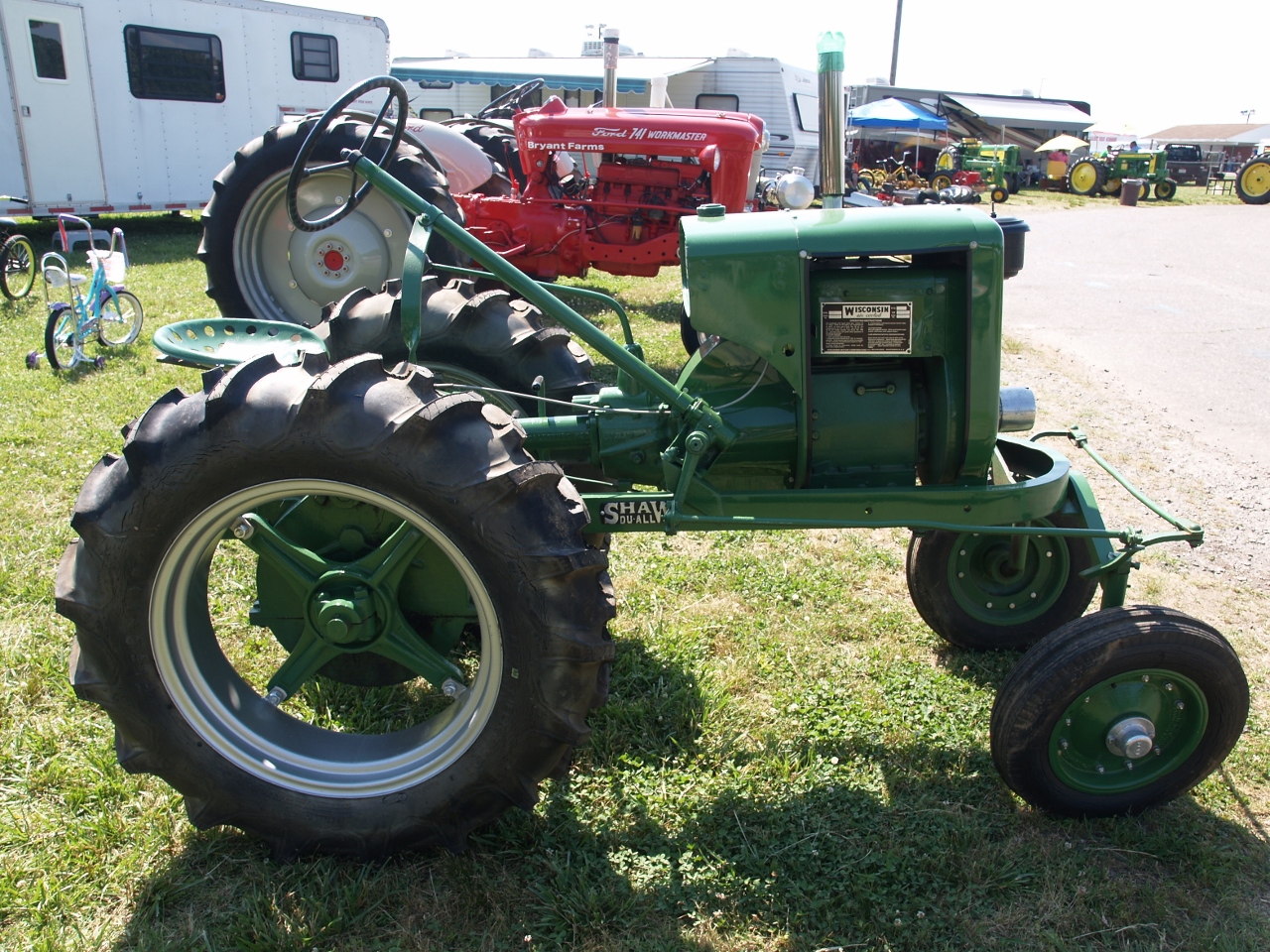
Shaw Du-All R 12 T
How big is a garden anyway? At what square footage does it stop being a garden and become a farm field? That was the question posed by Shaw Manufacturing Co. in their catalog number 21. It was also the question you might ask about the R 12 Du-All because it was somewhere between a “garden tractor” and a small full size.
Sunday, November 1, 2020
Six HP Witte Engine and a Dynamo
This post is about the known and the unknown. While what is commonly known can be interesting, the unknown usually holds a greater fascination. With that in mind, we’ll begin with what I’ve been able to learn and save the mystery for later.
Thursday, October 1, 2020
1929 Farmall
When it was introduced in 1924, International Harvester presented the Farmall as the revolution in agriculture that farmers had been waiting for. The claim wasn’t all hype. The standard wide stance tractor had proven it’s worth years before at tasks like plowing and belt work. The Farmall added row crop work like planting and cultivating to the list. Mr. Farmer could now collect a tidy sum by sending Ole Dobbin to the glue factory, not to mention saving the cost and time spent mucking out processed oats and hay from his stall.
Tuesday, September 1, 2020
Mayrath Garden Tractor
Martin Mayrath established Mayrath Machinery Inc. in Dodge City, Kansas and from 1949 until 1952 built tractors that were offered in three versions. The base model was a five horsepower, Briggs and Stratton engine mounted on a frame. According to the advertisement displayed with this tractor the transmission provided three forward speeds plus reverse. Forward speeds were two to 20 miles per hour. The price for this version was $295.