Monday, October 15, 2018

Desjardin 5 /6 HP Engine

Charles-Alfred Roy Desjardins began his business career as a shipbuilder. About 1865 he founded La Compagnie Desjardins at St. Andre - de - Kamouraska, Quebec in Canada and began producing  a variety of farm implements. His product line continued to expand and by 1911 it included gasoline engines and a small threshing machine that could be powered by an engine as small as one rated for four horsepower. These small threshing outfits held a lot of appeal for small farm operators because it freed them from depending on contract thresher men.


Around the turn of the last century Arthur Stanley Jones emigrated to the western provinces of Canada from England and established himself as a farmer. A farmer who lived nearby owned one of the Desjardins threshers and when Jones saw it, he realized the potential it held as a business opportunity. By 1912 Jones had become the agent for Desjardins in a territory that included Ontario, the western provinces and the northern states that bordered Canada. He sold Desjardin products in this area that were rebranded Call of the West. He was so successful in this enterprise that these engines are better known today than those that carry the Desjardins name.


By 1919 Jones had expanded his operation in Saskatoon to include offices, warehouses and a factory that made assorted farm implements and a blower for the threshing machines that Jones had deigned. An economic downturn in the early twenties hit the area hard and Jones was unable to meet the debt obligations his expansions had incurred. He sold his interest in the operation to Desjardins at what he claimed was a great loss. A few weeks later the factory mysteriously burned to the ground. Disputes soon arose over the insurance settlement, among other things, and both parties lawyered up. By the time the torts had settled, both sides were the worse for wear, but Jones seemed to have come out on top. He received a settlement from Desjardins and packed up and moved to California, never to be heard from in the manufacturing business again. Desjardins plodded on into the Great Depression and filed for bankruptcy in 1930.


You don’t see many Desjardins engines in my neck of the woods. In fact, this 5 or 6 horsepower 1918 example that Dennis Lamb brought to the 2016 Steam Expo at Cumming, Ga. is the only one I’ve seen.  There are a few photos posted online including one that Aumann Auctions sold for $971.25 back in 2016. Add a few video clips and that’s about it. They may be more common in Canada or out west where Jones sold them as Call of the West Engines. 


Sources: 
www.gasenginemagazine.com  Nov / Dec. 1987 article on A. Stanley Jones by Markham W. Hislop 
www.tonysengines.com/des-jardinengine 
http://buzzcoilbrinkster.net 
www.smokstak.com 
https://bidaumannauctions.com 

Monday, October 1, 2018

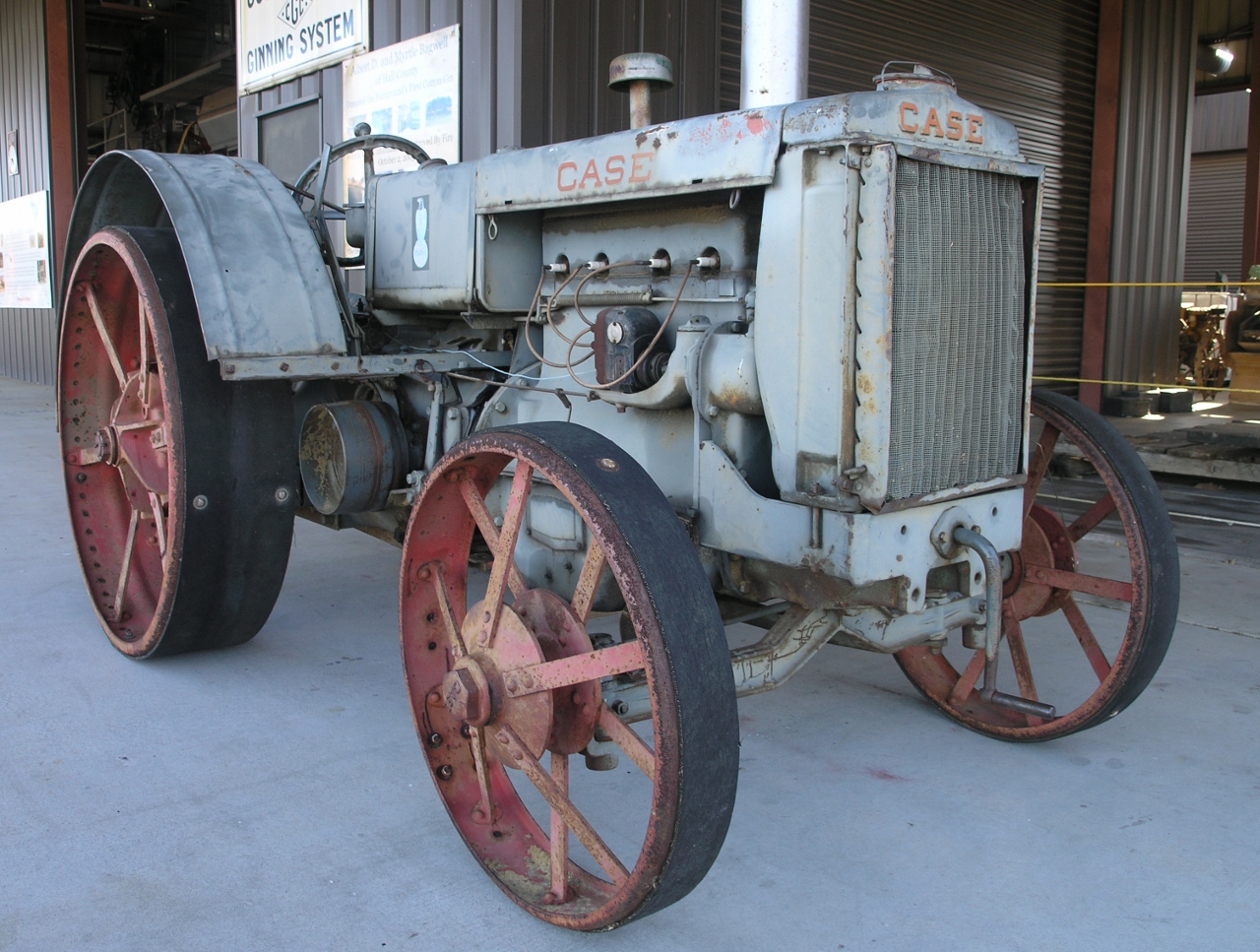
Case Model C

Toward the end of the Roaring Twenties the management at Case started to worry that the cross mount engine tractors it had been building since the early teens were looking antiquated compared to some of the sleeker models being produced by the competition. Some commented that even the normally unflappable “ole Abe” was beginning to look concerned.


R&D for a new design had been underway for a number of years and it all came together in 1929 with a smooth running, long stroke, inline four cylinder engine tractor they named the Model L.  A short time later it was followed by a scaled down version dubbed the Model C. Variants followed: with the C model being produced in row crop, CC, industrial, CI, orchard, CO  and a number of  specialized versions. 


The C was powered by a Case built four cylinder vertical I head engine. With a bore of 3 ⅞” and stroke of 5 ½” it displaced 259.5 cubic inches. At the University of Nebraska Tractor Test Number 167, conducted between August 12 and 19th 1929 it managed 27.33 brake horsepower and 17.41 drawbar horsepower in the rated load tests. 


Engine components noted in that test included a Robert Bosch model FU4ARS magneto, a Kingston Mod. L3  1 ¼” carburetor, a flyball governor and an oil filter air cleaner. 


Power was transmitted through a hand operated twin disc plate clutch located within the unit frame to a three speed transmission. Forward speeds were reported as low 2.30 mph, intermediate 3.28 mph, high 4.5 mph. Reverse managed 2.6 miles per hour. The final drive enclosed gear and chain system drove the 42 inch diameter rear wheels.


Total weight, without the operator, was recorded as 4000 pounds. Length was 114.5 inches, width: 61.5 “, height: 53.3”. 


Case produced the C model from 1929 until 1940. Sales were respectable for a depression era tractor. A total of 20,487 units of the standard model were built. The total when all variants are included reached 50,000 plus. 


The model C shown here was displayed at the 2017 Steam Expo. in Cumming, Ga. No information about it was provided.


Sources: 

University of Nebraska Tractor Test Number 167 report. www.digitalcommons.unl.edu 
www.tractordata.com 
Antique Power vol. 30 issue 3, March / April 2018 

Friday, September 14, 2018

The Czar's Decapods

Engine number 544 has a story to tell, one of the most interesting. I think, of all the exhibits at the North Carolina Transportation Museum at Spencer. Sitting in its stall in the Bob Julian Roundhouse, it doesn’t look particularly out of place but it doesn’t really belong here. It has  always been a stranger in a strange land. Although it was built by the American Locomotive Company in New York and spent its entire working life in the United States, in every other way, this is a Russian locomotive. 


In August 1914 the hapless Nicholas Romanov blundered into the trap the banksters in London, Paris,  etc. had set in Sarajevo, and committed the Russian military to the for profit meat grinder that would come to be known as World War 1. The ink on the declaration of war was barely dry before the officials in the Ministry of Railways made a horrific discovery. Russia’s railways and rolling stock were hopelessly inadequate to transport the necessary men and material required by mobilization. What was worse was that Russia’s locomotive manufacturing capacity would never be able to meet the need for more engines. These same officials also determined that even with more engines, the only way to meet the military requirements would be to increase the speed of the trains. 


In 1914 the standard for freight service in Russia was the 0-8-0 cross compound design but railroad officials quickly discovered that a new design with a  larger ( and heavier ) boiler would be necessary. After due study and deliberation they settled on the 2-10-0 “decapod” style engine as the best candidate to meet their unique needs.  This engine would have a boiler with 2600 square foot heating surface, a 700 sq. ft. superheater surface and a huge grate surface of 64 square feet. The engine would be single expansion with two cylinders 25 inches by 28 inches,bore / stroke.   


Orders were placed with The American Locomotive Co. in New York, Baldwin Locomotive Works in Philadelphia, Pa. and The Canadian Locomotive Co. in Ontario in June of 1915 for a total of 400 engines. The basic requirements, dimensions and specifications were sent from Petrograd by cable. The American builders filled in the details according to their usual practices. The first of these engines were ready to ship within two months followed by 350 more within four months. These early engines conformed to American design practice and basically looked like American locomotives that these firm routinely built. After this early lot arrived  in Russia the railway ministry placed orders for more that would bring the total to over a thousand engines. 


It seems that the Russian ministers were not entirely satisfied with the Americanized version so they dispatched the chief of the locomotive division, A.I. Lipetz, to the United States to modify the design and oversee production. The Russian decapods were designed to haul 1300 metric tons on grades of 0.8% at 8 to 10 mph, which was considered optimum for European railroads. Intended to burn soft coal they had a wide firebox with a deep throat that sat over the rear drivers. This firebox placement raised the centerline of the boiler to ten feet above the rails and gave these engines the profile that distinguishes them from the earlier american decapods. Out of the total of 1,081 locomotives ordered 681 were of the Russian design after the initial 400 had been shipped. The modified locomotives met with approval of the railroad officials and production proceeded, full steam ahead but events in Russia would preclude completing the contract. A total of 881 were eventually shipped but the last 200 built would remain in the United States. 


“A lie told often enough, becomes the truth.”  V.I. Lenin
Vladimir Ilyich Ulyanov was sitting poolside at a fashionable spa in Zurich Switzerland, sipping one of those deliciously bourgeois drinks that come with the little pink umbrella on top when the telegram from Mr. Big arrived from London. He groaned as he put his drink down on the table because he knew what it said before he opened the envelope. He always took great pride in being a “Professional” revolutionary. It was good work if you could get it, but it had its drawbacks. Now it was time to earn his paycheck. He opened the envelope. There was a private railroad car waiting for him at the station that would carry him and his crew across Germany and eventually on to Petrograd. His partner in crime, Lev Davidovich Bronshtein, was in New York City being feted by a gaggle of the kind of parlour pinks that city is famous for, when he received a similar message. The Czar had abdicated after war weary troops revolted in February 1917. The Mensheviks under Kerensky had completed the most important assignment which was to transfer the gold of the Imperial Government and the personal wealth of the Romanovs to banks in London and Switzerland under the pretext of repaying debt obligations ( at a six figure APR.). Now it was time to send in the Bolsheviks to loot and rape the rest of the country.  


Word of the atrocities being committed in Russia spread quickly and soon Lenin’s regime became an international pariah. Since the Bolsheviks had no legitimate claim to the remaining engines, they were never shipped. The engine that would become Seaboard Air Line # 544 was built in 1918 and conscripted by the wartime United States Railroad  Administration that had assumed control of the nations railroad system. It was converted from the 5 foot gauge standard used in Russia to the 4 ft. 8 ½” gauge used in the USA and assigned to branch line service in the Hamlet / Raleigh, NC area. It served this region into the 1950s when it was transferred to the Gainesville - Midland in Georgia. In 1965 it was placed on display in Atlanta, Ga. In 1980 it was sold to the North Carolina Railroad Company who in turn donated it to the State of North Carolina. In 1996 it was cosmetically restored and placed on display in the Robert Julian Roundhouse in Spencer, NC.   


Resources: 

The Railway Engineer Vol. 43 Jan. 1922, Russian decapod locomotives by A. Lipetz. Available at https://books.google.com 
The Russian Decapods by William D. Edson  at www.jstor.org . 
Exhibits information at www.nctrans.org .
Vladimir Lenin at https://enwikipedia.org  
The Fall of the Dynasties by Edmond Taylor  Skyhorse Publishing, NY, NY.
The Lost Fortune of the Tsars by William Clarke 

Saturday, September 1, 2018

1947 Leader Model D

Lewis and Walter Brockway were a father and son who operated a small repair shop in the equally small town of Auburn, Ohio during the 1930’s. Auburn was so small that it didn’t even rate a post office. Sometime toward the end of the that decade they put a garden tractor together using a four cylinder Chevy motor and transmission. Apparently the local population reacted favorably and the Brockways sold about twenty of them per year using the name, the American Garden Tractor Company.


In 1940 they changed the name to Leader Tractor Company and began producing a full size farm tractor but the engine remained the same as the previous version. 1944 saw the introduction of a row crop tractor with a six cylinder chrysler motor that they called the Model A. The Model B followed in 1945 when the power plant changed to a Hercules flathead four cylinder motor. The Model D was introduced in 1947 as a replacement for the Model B. It was at this time that “Made in Chagrin Falls, Ohio” began appearing on the tractor’s hood. According to some sources the move was made to make it easier for potential customers to contact the company by mail because Chagrin Falls, unlike Auburn, had a Post Office.


The Model D was built from 1947 until 1949 and proved to be the best selling tractor that Leader ever produced. The Hercules 4 cylinder gasoline engine displaced 133 cubic inches to produce 31 hp. The company claimed a 2 plow rating. Three forward speeds plus reverse were provided. A rear mounted pto turned at 540 rpm to power attachments. The D weighed in at 2500 pounds distributed over a 70 inch wheelbase.  Apparently, demand outpaced production. 


It was at this point that the Brockways made a fatal mistake for the future of Leader Tractors. The tractors had always been distributed through a chain of Ohio car dealerships owned by the Schott Brothers who offered to loan the Brockways funds to expand the factory’s production capacity. Ignoring the cardinal rule of dealing with car salesmen they failed to read every word of the contract they were signing. Hidden deep within the fine print was a payable on demand clause. In 1949 the Schotts called in the loan which the Brockways were unable to pay and were forced to forfeit their interest in the company. The Schotts then closed the factory and liquidated the assets. Or so the story goes. It seems to me, there must be more to this than we are being told. Why would the Schotts close down a supposedly successful venture?


The Brockways were not deterred by this setback and were soon back in the tractor business building a tractor they called the Brockway in a factory in Bedford, Ohio. The new tractors were in production the same year as the Leader operation was being closed down. The Brockway was manufactured until 1959 with an undetermined number being sold.  Most of the sources I found online cite production of all the models being very limited, numbering in the hundreds at most, yet a member of the Brockway family has claimed that tractors were shipped by the thousands.


If anyone could answer that question it should be the members of the Leader Tractor Club but there was a problem, the website has a Mugbook address. I have always disliked everything about Mugbook, from the ostentatiously adolescent “cool” CEO to that sophomoric “Like Us” stuff. When I see that address I keep looking for another source. This time however I decided to vent, so I clicked the link, just so I could speak from recent experience. Instead of landing on their homepage you’re confronted with a pop up telling you to sign in or create an account. Not likely, I already have enough spyware, thank you. Goodby Mugbook. Not to disparage the members of the Leader Tractor Club but your website gets a big thumbs down. If you are going to spend the time and energy to create a web presence, why use a third rate platform? There are many better content management systems available. As Elon Musk said when he took his page down, “ It looked lame, anyway.” So true! Bottom line, I didn’t find the answer to the question.


The 1947 Leader Model D shown here was on display at the Steam Expo. at Cumming, Ga.  in 2016. The owner, Mickey Skohow was offering it for sale for $2850 at the time. 
Sources:
www.farmanddairy.com  Leader tractors put Auburn, Ohio on the map, by Sam Moore, March 15, 2012 
https://en.wikipedia.org 
www.tractordata.com

Tuesday, August 14, 2018

Hercules and the Pyramid

To my knowledge no one has ever suggested that Hercules built the Pyramids, or even visited them as a tourist ,but a Hercules engine was definitely powering this Goulds Pyramid pump at the 2018 F.A.P.A.S.C. Power from the Past Show back in May.


The Marketeers of the late 19th and early 20th centuries were particularly fond of naming their products after the heros from classical mythology. At one point there were three manufacturers of engines trying call their products Hercules engines. The Evansville, Indiana firm that made these small engines had no connection to the better known Hercules Engine Co. of Canton, Ohio that manufactured engines for trucks. Like most such disputes, this one was eventually hashed out by the lawyers. 


The Evansville firm had its roots in Cincinnati, Ohio with a company called the Brighton Buggy Works that built buggies that were distributed by Sears, Roebuck and Company. The ties to Sears would remain throughout the existence of the firm.  Around 1902 a factory was constructed in Evansville and the name was changed to Hercules Buggy Co. When Sears decided to venture into automotive products by motorizing its buggies, engines to power them were built at the Evansville plant. In 1912 production of stationary engines began and the name was changed to Hercules Gas Engine Co. 


The stationary engines Hercules made for Sears were sold under the Economy trade mark, but they also built engines for other retailers. Hercules built engines were sold with brand names such as Ajax, Arco, Atlas, Champion, Jaeger, Keystone, Reeco, Thermoil and Williams. In 1914 150 engines were built daily. By the time the Evansville plant shut down in 1934, more than 400,000 engines had been produced. In spite of this apparent diversification the company’s fate seems to have been irrevocably linked to Sears. In 1929 Sears canceled it’s agreement with Hercules and contracted with the Stover works to supply stationary engines. This appears to have been a mortal blow and the Great Depression did the rest. Hercules Products closed its doors for good in 1934. 


I can’t provide much information about the engine shown here. The data plate on the engine is nearly illegible. It looks like it might be 2 ½ hp and SK but that’s not for certain. Likewise the engine number appears to be 349186. Maybe some engine expert out there can offer some details.  


Pumps made from wood were being manufactured in Senaca Falls, New York  as early as 1839 by a company named Paine and Caldwell. One year later a man named Abel Downs opened a shop and began building his own brand of pumps. His company would become Downs & Company in 1848 when Seabury Gould bought into the firm. 


Goulds background was operating a foundry where he made a variety of products and in 1849 he cast the first all metal pump. His design was so well developed that versions of this hand operated pump are still being sold today and judging by early illustrations the appearance is basically the same. A 1906 edition of Sweet’s Indexed Catalogue of Building Construction , available in digital format at books.google.com  has an illustration of Goulds Pitcher Spout Pump as well as one of a Pyramid Pump. Both look similar to the pumps in this photo. The catalogue describes the Pyramid pump as, “ A double acting piston pump with a 55 lbs pressure or 125 ft. elevation. This pump is used for tank pump in residences, apartment houses, factories, railroad water tanks, etc.”   Fifteen different models of Goulds pumps are shown in this 1906 publication. 


Goulds continued to increase his stake in the company and by 1869 the name had been changed to Goulds Manufacturing Co. Throughout this period the company was an innovative leader in its field. Goulds developed one of the earliest steam powered pumps. The factory and main office remained in Seneca Falls but branches were established in New York City, Boston, Mass,, Chicago, Il, and Pittsburgh, Pa. 


In 1926 the name changed again, this time to Goulds Pumps Inc. It would remain a family owned and managed business until 1964 when the company went public.  Goulds built pumps for every usual application. In addition to hand operated pumps their pumps were designed to be powered by belt from line shafts, direct from steam engines or gas, oil, gasoline,  engines or electric motors .


Goulds Pumps have proven to be a survivor. In 1997 they were acquired by the ITT Corporation. In 2011 the pump manufacturing division was spun off as a separate company and named Xylem Inc. The name Goulds still appears on pumps built in Senaca Falls, New York. with no end in sight. The company just completed a 27 million dollar plant expansion early in 2018.  


Resources:
https://en.wikipedia.org 
www.gasenginemagazine.com 
www.archives.hcea.net 
www.tractorfriends.org 
www.gouldspumps.com 
Books.google.com 


Wednesday, August 1, 2018

Caterpillar Ten

Even before Holt Manufacturing Co. and C.L. Best Tractor Company merged in 1925 to form the Caterpillar Tractor Co., there were “ Caterpillar “ crawler tractors. Holt began experimenting with track layer designs in 1906 and was in production by 1908. Legend has it that somebody’s kid was watching a demonstration and exclaimed “ It moves like a caterpillar!” and Holt picked up the expression and began applying it to their crawler tractors.  By 1914 Holt’s tracklayers were well developed and were in great demand by the British and French armies who used them for hauling artillery and  supply wagons through the mud on the Western Front.  They were so successful in this application that they may have been the inspiration for the first tanks.


The Caterpillar Ten was developed in 1928 as a replacement for the popular 2 ton model in the company’s product line. Production began in December but only a handful were actually produced with serial numbers running from PT 1 to PT 7 according to a list published at chriscomachinery.com . 1929 was the first full year of production with serial numbers running from PT 8 to PT 3173. The number stamped on the data plate of this example is PT 1420, putting it in the middle of this range. 


Small crawler tractors have always been well received because there are a number of things that they do very well. The floatation developed by the area of the tracks enable them to operate where wheeled machines would quickly bog down. Sitting close to the ground with a low center of gravity gives them an advantage when being used in hilly terrain. They are especially favored by orchard operators. Between 1928 and 1932 Caterpillar manufactured around 4929 copies of the Ten that sold for $1,100 each. 


A model Ten was sent to the University of Nebraska Lincoln where it was evaluated from May 6th to May 21 1929 in test number 160 where the following specifications were recorded. 


Caterpillar built their own 4 cylinder vertical “L” head gasoline engine for the Ten that had a bore of 3 ⅜” and a stroke of 4”. Turning at 1500 rpm it recorded a rated 15.26 brake horsepower and posted 10.10 hp drawbar. Ignition was by way of an Eisemann mod. G4 magneto. The carburetor was an Ensign mod. Bet 1”. Air was cleaned through a Pomona Vortex oiled filter. Lubrication was by pressure and splash. 


A foot operated single plate clutch assisted shifting the gears that provided speeds recorded  as: low 2.02 mph, intermediate 2.59 mph, high 3.50 mph and reverse 2.07 mph. Power was transmitted by way of an enclosed gear drive. Tracks measured 13.9 feet in length by 8 inches across the face.  A belt pulley measuring 9 ½” in diameter with a face of 6 ½” turning at 1050 rpm was available for power takeoff. 


The Caterpillar Ten shown here is owned by the Culp Family and was exhibited at the Tractors and Trains Festival 2018 at the NC Transportation Museum, Spencer, NC.


Resources:
University of Nebraska Tractor Test number 160
https://books.google.com  Caterpillar Chronicle: History of the Greatest Earthmovers by Eric C. Olemann 
www.caterpillar.com 
Encyclopedia of American Farm Tractors by C.H. Wendel 

Sunday, July 1, 2018

The Minneapolis 27-42

There are more twists and turns to the corporate genealogy of Minneapolis-Moline associated tractors than there are on the serpentine belt of a modern automobile, so I’ll leave the telling of that story to the pros, like I do with working on the one under the hood of my truck. For this post, just touching on a few of the relevant highlights will suffice. 


This tractor was a product of the Minneapolis Threshing Machine Company of Hopkins Minnesota, that traces its roots back to 1874 when it was known as the Fond du Lac Threshing Machine Company, but only just barely. In 1929, the year it was produced, MTM merged with Minneapolis Steel & Machine Co. and the Moline Implement Co. to become Minneapolis Moline Power Implement Company. See how complicated this is getting? 


 Minneapolis Threshing Machine was a well established tractor manufacturer by 1929 with a solid reputation for building a quality product. The name on the badge may have changed but the tractor remained  in production until  1934 according to C.H. Wendel in his Standard Catalog of Farm Tractors. I’ll just have to take his word for that because I haven’t found a list of serial numbers anywhere. The closest thing to a confirmation is a mention in a publication called The Tractor and Implement Blue Book that was printed in 1932.


The one thing that is certain is that the 27-42 was in production in 1929 because it was tested at the University of Nebraska from May 28 to June 11 of that year in test # 162. The information provided by that test report is just about all that I’ve found that’s available online.


MTM built its own motors, in this case, a four cylinder vertical I head that was mounted crosswise to the frame. Bore of each cylinder was 4 ⅞ “ by a stroke of 7” for 522.6 cubic inches displacement. Turning at the rated rpm of 925 it produced the claimed 27 hp on the drawbar and 42.3 hp on the belt. Power take off was by way of a 15 ½” diameter belt pulley with a 7 ½” face that also turned at 925 rpm. 


Ignition was by an American Bosch Magneto. Gasoline was metered by a Stromberg model UTR carburetor and a flyball governor controlled engine speed. Air was filtered through a Donaldson Simplex oiled fiber air cleaner. 


A Madison-Kipp force feed oiler provided lubrication to critical surfaces. Once the engine was running the oil was pumped automatically. The hand crank handle was for providing a few drops of lubricant before starting the engine. 


Power was transferred to the 53” diameter rear drive wheels by way of an enclosed gear system. The disc clutch was hand operated. Two forward speeds were provided; low, 2.6 mph. High 3.4 mph , reverse, 2.5 mph. Fifty-four spade lugs on each of the rear wheels helped the tractor’s total weight of 8373 pounds get a grip. 


The tractor shown here is owned by Bobby Cartner and was exhibited at the 2018 Tractors and Trains Festival sponsored by the North Carolina Transportation Museum  at Spencer, NC.
Resources: 
https://digitalcommons.unl.edu 
www.tractordata.com 
Books.google.com