Thursday, September 1, 2016

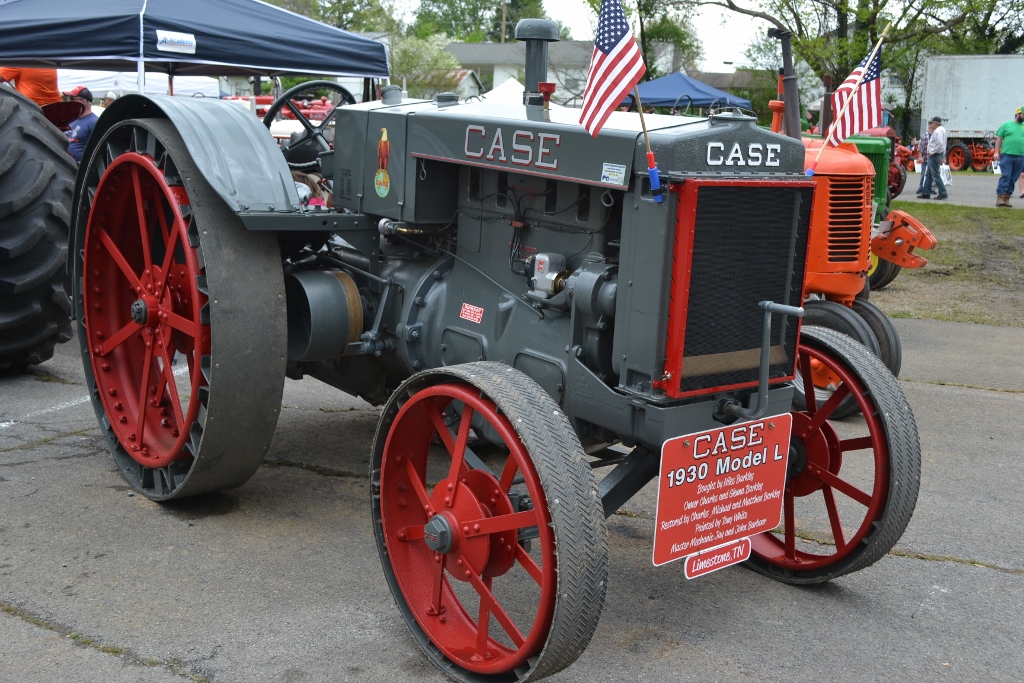
1930 J.I. Case Model L


Looking like it just rolled off the the J.I. Case assembly line in Racine Wisconsin, This 1930 Model L was exhibited at the Tri- State Antique Power Association 2016 Show by owners Charles and Glenna Barkley.


In production from 1929 to 1940 Case manufactured 31,678 Model L tractors over that 11 year production run.


Rated for 3 to 4 plows and weighing in at 5307 to 8025 pounds it was a big, powerful tractor for it’s day. Powered by a Case 403 cubic inch four cylinder engine it provided ample power for plowing and was especially popular for belt work like threshing and powering sawmills.


Case literature claimed 32 hp on the drawbar and 45 hp from the PTO but the Nebraska Test rated it at 40.8 drawbar and 47.04 hp on the belt. For those who might be wondering what a Nebraska Test is, an interesting digression is in order.


Back in the day before politicians discovered they could create a “Foundation”  to
launder their bribes, kickbacks and payola from foreign powers for facilitating espionage, some of them actually had to work for a living. Like most of his constituents State Representative Wilmont F. Crozier was a farmer and he had been repeatedly burned by fly by night tractor salesmen. Together with State Senator Charles J. Warner he introduced a bill that became the Nebraska Tractor Test Law in 1919. Every tractor sold in Nebraska was required to be evaluated by a team of engineers at the University of Nebraska at Lincoln. The results of these test were then made available to the public.


Testing began with a Waterloo Boy Model N 12-25 on March 31, 1920 and has continued to the present day. It has proved so valuable to consumers that it quickly became a national and is now an international standard. You can view and download the report on your favorite tractor’s performance by visiting the University of Nebraska Lincoln website at www.digitalcommons.unl.edu/tractormuseumlit


Sources:

Monday, August 15, 2016

Stover's Good Engine

As opposed to one of Stover’s bad engines? This interesting little engine was exhibited at the Foothills Antique Power Association’s 12th annual show in 2015.


During the 19th and early 20th Centuries it seems like everyone wanted to cash in on the manufacturing bubble and Daniel C. Stover ( 1839 - 1908 ) was no exception. In 1879 he established Stover Manufacturing Co. located in Freeport Illinois. The firm produced a variety of items that included agricultural machinery, water tanks, saw mills, the Ideal brand windmill for well pumps and the line of gasoline engines. Stover also made bicycles and in 1889 was issued a patent for improvements to bicycles  that included the coaster brake that is still used today on what’s called “cruiser bicycles”. Stover’s products were widely distributed through Sears, Roebuck & Co. If you fly on over to www.idaillinois.org you can find a nice “ Aeroplane view of the big Stover plant “ as it appeared on postcards of the period. Stover Manufacturing continued in business until 1942.


A point of interest is the Wico Electric Co. type EK Magneto that was widely used on single cylinder gas engines of the period. A reciprocating armature induction magneto, the only moving parts were the armature and contact points. It was  renowned for it’s simplicity and reliability. Printed on the Magneto is an amazing warranty. “Guaranteed for all time against defects in material and workmanship.”  Wow! Where can you get a product like that these days? Presumably one day billions and billions of years in the future, just before the universe stops expanding and collapses back into an infinitely dense point, if your engine stops working due to one of those defects; you could get your money back. That is of course provided you could find a Wico Company representative.


Sources:

www.gasenginemagazine.com  The remarkable Wico Model EK Magneto by Bud Motry May / June 1977
Illinois Digital Archives www.idaillinois.org


Monday, August 1, 2016

McCormick - Deering 10-20

The 10-20 rated by International Harvester as a 2 plow general purpose tractor was one of the best sellers IHC ever produced. A list of serial numbers posted at www.tractordata.com runs from KC 501 in 1923 to KC 214886 in 1939 for a total of well over 200,000 units. This nicely restored 1937 model was exhibited at the Tri-State 2016 Show by Gordon Mawhiney who brought it all the way from New York.


Conservatively rated in company literature  as providing 10hp on the drawbar and 20hp on the belt, the results from Nebraska Test # 95 in 1923 gave the tractor 15.54 at the drawbar and 21.84 on the belt.


The following information and quotations are from an International Harvester catalogue of the period. “ McCormick-Deering tractors are equipped with vertical 4 cylinder valve in head engines. These engines operate economically and satisfactorily on kerosene (coal oil) and other low priced fuels.”


International Harvester used do it yourself maintenance as a selling point. That may be why you see so many of these tractors still sitting in fields today.
“Each cylinder is cast separately and fitted into the engine block. These cylinders may be easily replaced in case they become scored or worn.”


America didn’t run on batteries back in the day. “ High tension magnetos supply current for the jump spark ignition. The magnetos are equipped with impulse starters and the engines start and run on the magnetos. No batteries are needed.”


“Selective type of transmissions are used and all gears run in an oil bath. The transmission may be removed as a unit.” “ The power is transmitted to the drive wheels through large steel spur gears which run in an oil bath and are carefully protected from dust and dirt.” Three forward speeds; 2-3-4 mph were available plus one reverse speed of 2 ¾ mph. “The two mile speed for heavy pulling, three mile for plowing and four mile for hauling.”


The 15-30 was rated as a 3 plow tractor and was somewhat larger than the 10-20 although a casual observer would have a hard time telling them apart. The 15-30 had a bore of 4 ½ “ and stroke of 6” as opposed to 4 ¼ “ x 5” on the 10-20 that gave it the advantage in horsepower.


The Wisconsin Historical Society has done an exemplary job of making valuable resources from their collection available online at www.wisconsinhistory.org . This is a must visit for anyone with an interest in antique International Harvester products. Although the website has plenty more to offer; you could spend days just browsing the McCormick - International Harvester Collection. No doubt there are thousands of similar treasure troves buried in the vaults of museums that never see the light of day because no one has made the effort to make them available. If you have a likely suspect where you live, ask them what they are doing to make their collections available online; you just might get the ball rolling and do a lot of good. Thanks also to exhibits at the 2014 WNC Fall Harvest Days show and the Woodfin Collection.


Saturday, July 16, 2016

1939 Caterpillar R2

You don’t see many crawlers at the shows around here. I suspect that is at least partly due to the logistics involved in moving them. Weighing in at a hefty  6130 pounds you can bet that it took more than a little effort to haul this Cat through the mountains to Gray, Tn. for the Tri-State Antique Power Association Show back in April.


The placard you see propped in the operator’s seat informs us that this is one of only 1185 4J series Caterpillar Model R2 units built between 1938 and 1942. The Antique Caterpillar Machinery Owner’s Club website ( www.acmoc.org ) places total R2 production at a slightly higher 2418 between 1934 and 1942. This website features a very detailed history of Caterpillar that is worth a look.


Built at the Peoria IL. plant in 1939 the 4 cylinder 251 cubic inch engine was rated at 25 hp. At the drawbar and 30 hp on the belt by Nebraska Test # 320.


This nicely restored example is part of the Christenbury Caterpillar Collection brought to the show from Liberty, NC.


Friday, July 1, 2016

Total Eclipse


“Be sure you are right, then do it quickly.”  Good advice for almost any undertaking. It was George Frick’s personal motto and it served him well.


Born in Lancaster County, Pa. in 1826 at a time when the sleepy pace of thousands of years was changing very quickly; he was immersed in the technology of his day from childhood. By the time he was nine years old he was helping his father operate a water wheel powered sawmill near Quincy, Pa. At seventeen he was apprenticed to a millwright in Ringold, Md. a few miles away. He had little formal education, like most of his contemporaries, but he had an aptitude for math and an intuitive understanding of all things mechanical.


By the early 1850’s he was building an assortment of farm machinery and his first 2hp. Steam engine in his machine shop and foundry in Ringold.  In 1853 he established The Frick Co. By 1857 he had added threshing machines to his product line and around 1860 had moved his company into a larger shop in Waynesboro , Pa.  The 1870’s saw the addition of traction steam engines and sawmills to the list of products manufactured by Frick. This Frick sawmill dates to at least the mid 1930’s. It was donated to the Foothills Antique Power Association of NC. by Ira and Ann Cline and was in operation at the 12th Annual Power Show in 2015. It is being powered by the Eclipse traction engine in the background.


About 1876 Frick began using the Eclipse trademark on steam engines. Eventually the entire product line of portable and traction engines, boilers, threshers and sawmills would use the name. By 1879 the company was publishing a house magazine called “The Eclipse Era”.  The 1880’s were a period of rapid expansion for the company. A new plant was built in Waynesboro, Pa. that was a marvel of modern manufacturing. It was featured in an article published by the Scientific American magazine. Sales offices were opened around the country. A Frick catalogue published in 1907 listed 19 locations including this one in Salisbury, NC. Other branch offices in the Southeastern USA included: Winchester, Va., Baltimore, Md., Charleston, W.Va., Nashville, Tenn. and Atlanta, Ga.


In 1882 Frick built its first ammonia refrigeration compressor and entered a field that carried the firm far past the era of steam power. Frick became an industry leader building some of the largest refrigeration plants ever constructed. Food processing plants, ice houses, skating rinks all used Frick products. Compressors like this one provided refrigeration wherever cooling was needed. Known for their long life and dependable service they were built to run forever. Forty years of daily service was not unusual. This one was probably still operable when the packing house it served was shut down and abandoned.


After 43 years at the helm of the company he founded, George Frick retired in 1888 but Frick Manufacturing soldiered on.  His son A.O. Frick served as president from 1904 to 1924 followed by Ezra Frick from 1924 to 1942. In 1953 to celebrate a century in business the company published a small book titled A History of Frick Company Waynesboro, Pa. which is probably one of the best sources you will find online and is well worth a look. Visit : https://archive.org and search for Frick history . You’ll be glad you did. Frick was purchased by York in 1987. Refrigeration equipment is still manufactured today under the Frick name by Johnson Controls.


While you’re at archive.org take a look at a general catalogue of Frick products available in 1907, a very interesting historical document, full of photographs and illustrations. The web address is:  https://archive.org/details/1907Frick


According to a list of Frick serial numbers posted at www.oldengine.org  serial number 7883 would have been built in 1899, and here it is, powering a Frick sawmill in 2015. They sure don’t build em like they used to.


Additional resources:
www.farmcollector.com  George Frick and his Steam Empire by Sam Moore, March, 2012
Encyclopedia of American Steam Traction Engines by Jack Norbeck

Wednesday, June 15, 2016

Old Rusty

To paint, or not to paint: that is the question.


Whether ‘tis nobler to suffer the pits and flakes of outrageous corrosion.Or take up spray gun, and by opposing end them.


So who wouldn’t want a tractor that looks, and probably runs, better than it did when it rolled off the assembly line half a century or more ago.


For the hardcore collector this kind of dithering isn’t an option. Nor is a good night's sleep as he lies awake, listening for the  unmistakable ping of a rust flake separating from base metal emanating from the tractor shed. Every atom of rust must be sand blasted and wire brushed into oblivion.


The thing is, at a show I always find myself being drawn to the unrestored exhibits. They have an air of history that gets removed along with the rust and grease and peeling paint. At the end of a total restore what you have is a new old tractor and wasn’t that history what attracted you in the first place? It is a dilemma.


There is however, a third path; midway between the untouched and total restoration. You could embrace the rust and make it your friend.


In the Rat Rod community rust is considered to be a precious metal and a patina like the one on Old Rusty is to die for.


The debate about how to best preserve your rust rages on bulletin boards and in chat rooms. Is clear coat the way to go or not? How about oil and what kind works best? Boiled linseed oil has a large and loyal following. So what is Ole Rusty’s secret? My guess would be lots of elbow grease followed by plain old car wax but what do I know? If you are privy to the inside skinny, or just have a favorite secret formula you want to share, please leave a comment.