Monday, February 1, 2021

Pattin Brothers Oil Field Engine

 What did Mobey Dick, John D. Rockefeller and the Pattin brothers have in common? They all benefited from the Pennsylvania oil boom. 

The oil had been there, almost since time began. It was so close to the surface that in some places around Titusville it oozed out onto the ground. The Native Americans had collected it for centuries to use as an insect repellent and ointment. Beyond that it had little value. The early European settlers regarded it as a nuisance  because the soil it contaminated was no good for growing crops but the mid nineteenth century would see a drastic change.


In 1849 if you stayed up after sunset you lit a candle or a lamp that burned whale oil. The demand was huge and fleets of whaling ships roamed the seas. As many as 15,000 right whales were being turned into barrels of oil in a single year. Whale oil was the world’s illuminant of choice but it was also expensive. A Pennsylvania resident by the name of Samuel Kier began to experiment with ways to refine the crude oil that was so abundant in the area into a usable fuel. In 1850 he formed a company to market his improved lighting oil as “Carbon Oil.” Kier’s business met with success so he soon had many imitators. 


A group of New York investors formed a company they called the Pennsylvania  Rock Oil company and hired a man named Edwin Drake to prospect for oil in the region. You might think that he was a geologist but that was not the case. Drake was an unemployed railroad conductor with no previous experience in prospecting for oil. Consequently, he drilled a lot of dry holes before he finally struck oil in August of 1859. The Oil Creek Boom was off and running. Production that year was only 2000 barrels but by 1873 over ten million barrels were pumped from the ground. 


In the 70’s John D. Rockefeller’s company,  Standard Oil, began buying up land and oil wells in an effort to monopolize oil production, By 1882 he had largely succeeded. Pennsylvania oil peaked at 31 million barrels in 1891 and the region was soon passed by other states like Texas and Oklahoma as the center of the oil industry, but the region would continue to pump oil for decades to come. The abundance of petroleum resulted in falling prices. With petroleum selling for 7cents per gallon, few would pay $2.00 a gallon for whale oil. It wasn’t long before Mobey had a lot fewer Ahabs chasing him around the Seven Seas, and that, Greta, was how the petroleum industry saved the whales.  


In 1888 Winfield and Douglas Pattin formed a partnership with J.G. Hall to open a machine shop in the town of Marietta, Ohio. The oil boom was in full swing in the surrounding countryside so the new shop naturally catered to the needs of the petroleum industry. In 1895 Hall sold the brothers his interests in the company and the name changed to Pattin Brothers & Co. In the early years steam engines supplied the power for drilling wells so the new company added them to their product inventory but within a few years gas engines had largely replaced their steam engines.


Douglas Pattin was killed when a natural gas leak exploded and leveled a large part of the factory.  Winfield would run the firm until 1913 when he contracted pneumonia and died while on a business trip. A man named William Meister who had signed on as an apprentice in 1891 and worked his way up into management, took the helm and ran the company up to the mid 1940’s when Patin Brothers & Co. was purchased by the Acme Fishing Tool Co.    


The engine shown here was used to pump natural gas in a pipeline from the oilfields. It dates from the early 1900’s according to a sign posted above the display. It is part of the Foothills Antique Power Association of NC’s collection that is on permanent display at the Hickory American Legion Fairgrounds in Newton, NC.  

Sources:

www.coolspringpowermuseum.org  The flywheel Sept. 2014  Pattin Brothers : Ohio’s Oil Field engine by Paul Harvey 
enwikipedia.org/wiki/pennsylvania_oil_rush  
petroleumhistory.org/oilhistory/pages/whale/whale.html 
sjvgeology.org/history/whales.html      


Friday, January 1, 2021

Gainesville-Midland Number 209

 I was passing through Gainesville, Georgia on my way to the Steam Expo. when I spotted this engine. Steam locomotives are my favorite so it was time to take a stretch break. After walking all around the engine I realized that I hadn’t seen any signs or information displays. Maybe I had overlooked something so I walked around again looking for any signs I might have missed.  No doubt this time, there just weren’t any, I thought this was odd since the town had gone to considerable expense to create a nice display. It was the beginning of a pattern that would repeat itself. 


As if to make sure that the curious were denied all information, someone had removed the identification plates from both sides of the boiler. Was this the work of a souvenir hunter? Maybe, but I doubt it. Those plates are usually attached to the boiler with some fairly substantial rivets. At this point I had some photos but no info about what it was. 


Time passed. When I got around to researching this post I emailed the city of Gainesville to see what light they could shed on the history of No. 209. The contact person replied that she would ask around and get back to me. In the meantime I might want to contact the local historical society, I had planned on doing that anyway so that was my next move. I’m still waiting to hear from the city. I guess they’re content to use it as a holiday ornament and let it go at that. 


The people at the historical society replied by sending me a pdf of an article that had appeared in the local newspaper: “Uncovering the Past, Gainesville-Midland # 209” by David French. In it Mr. French refers to a book titled: The Gainesville-Midland and her Sister Short Lines by Douglas Van Veelen. In his book, Van Veelen asserts that # 209 was built by Baldwin in March of 1930. Mr French writes that no sources were referenced and that Van Veelen offered no explanation of how he came by this knowledge but he accepts it at face value. 


There are a number of reasons that I question Van Veelen’s assertion about  the origin of this machine. First and foremost is the fact that it looks like one of the Russian decapods designed and constructed in 1917 under the supervision of A.I. Lipetz, the head of the locomotive division of the Russian State Railway. You can compare this engine to one of the pictures a search for Russian Decapods will produce and judge for yourself. The boiler mounted high above the drivers and the location of the firebox on #209 are distinctly Russian. Baldwin did build 2-10-0’s for American railroads, but they looked similar to most other engines operated in this country.


The Decapod design filled a very narrow niche market because they did one thing very well, pulling heavy loads on steep grades at low speeds. The Pennsylvania Railroad was one of the few in the USA that operated a large fleet of decapods. All told they used 598 2-10-0’s on their Allegheny Mountain routes where the design excelled for slow drag service. The Gainesville Midland on the other hand, was a short line that ran from Gainesville to Athens Ga. an area that isn’t exactly mountain country. 


The Russians placed the largest orders for 2-10-0’s by far that American builders ever received. In 1917 the Czar’s government ordered 1057 of which 857 were shipped before the Bolsheviks stole the country. During World War ll another 2200 were built ( and no doubt paid for as part of lend lease, with American taxpayer dollars ) for our wonderful allies, the Soviets. With these two exceptions, orders were few and far between. American railroaders just preferred the 2-8-0 design. It’s those 200 that were left in country during the First World War that are of interest here.


When the United States entered the war, the nation’s railroads were effectively nationalized and the 200 decapods were drafted into the service of the United States Railroad Administration. Those 200 engines would be distributed to railroads across the country and most were put into service on short branch lines. Seaboard assigned it’s allotment to the Hamlet / Raleigh area where they served until the early 50’s when a group was transferred to the Gainesville Midland. It seems to me that this is the most probable explanation of how # 209 arrived at its present location.


Sources:


There are a number of variations on this story. Just do a search for Russian Decapods or 2-10-0’s. Here are some of the sites I visited.

www.steamlocomotive.com 

www.locomotivefandom.com 

www.enwikipedia.org/wiki/2-10-0 

www.trn.trains.com 

www.jstor.org  The Russian Decapods by William D. Edson 

https://books.google.com The Railway Engineer Vol. 43 Jan. 1922 Russian Decapod Locomotives by A. Lipetz 


Tuesday, December 1, 2020

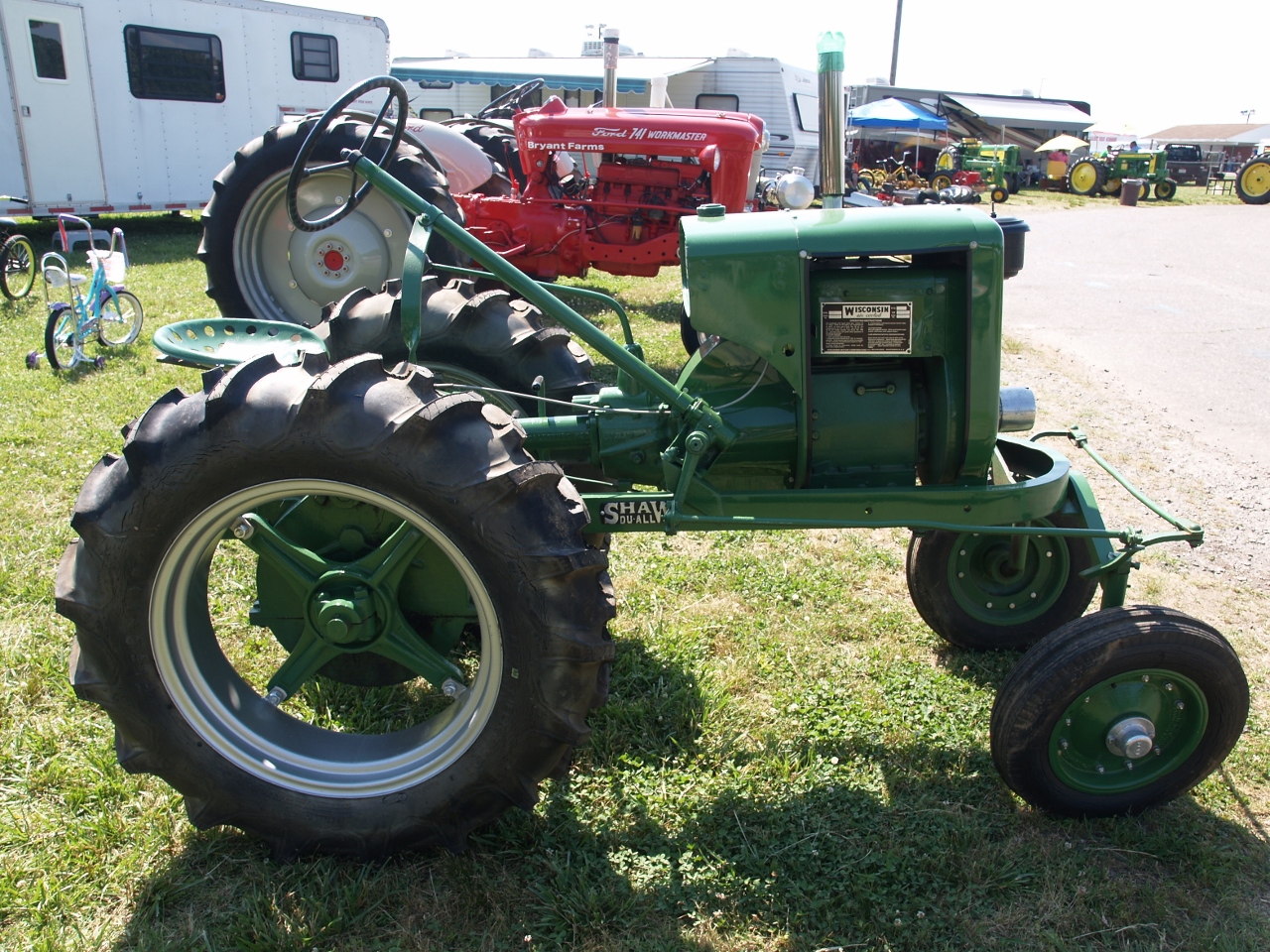
Shaw Du-All R 12 T

 How big is a garden anyway? At what square footage does it stop being a garden and become a farm field? That was the question posed by Shaw Manufacturing Co. in their catalog number 21. It was also the question you might ask about the R 12 Du-All because it was somewhere between a “garden tractor” and a small full size. 


Powered by a two cylinder, air cooled Wisconsin TF engine that pumped out twelve horsepower it was the top of Shaw’s line and in direct competition with tractors like Deere’s L and LA and International’s Farmall Cub. Shaw contended that their tractors could do the same jobs more economically than a full size tractor.


Catalog # 25 was published in 1953 and marked the 50th anniversary of production of gas engines and garden tractors. Gas engine production it said, had been sidelined several years previously to meet demand for the tractor products. The tractors shown in earlier catalogs were mainly walk behind  models. By 1953 they had  been replaced by riding tractors. 


The R 12, it said,could handle a 14” plow in most soil conditions. Accessories offered included: hydraulic kits, cultivators, cutter bars, disc harrows, disc plows, hauling carts and hay rakes. Lawn mowers, snow plows, bulldozer blades, planters, sprayers and end loaders were also available. 


The R12 had a wheelbase of 60 inches and was mounted on 7” by 24” rear tires, 4” X 12” in the front which gave it a 24 inch plant clearance. The transmission was described as “selective sliding gears, synchronous automotive type. Speeds ranged from 2 ½ to 7 miles per hour. It weighed in at 1150 pounds. 


By the time catalog # 21 was published, ( unfortunately they didn’t date the earlier ones ) Shaw had operations in Columbus, Ohio, New York, NY., and Chicago, Ill. as well as their factory and main office in Galesburg, Kansas. Apparently this did not last as later publications don’t mention them. 


According to Shaw, “ Many customers drive to our factory and haul our riding tractors in trailers. Some drive more than a thousand miles. One customer purchased a R 12 T tractor and drove it home across several Kansas counties, across an adjacent state and into the third state.”  Shaw’s shipping and handling charges must have been predatory. I think I would beg, borrow or steal a truck or a trailer before taking an interstate drive on a lawn tractor. 


Source:
Oldirongardentractors.files.wordpress.com  provided all the information used for this post. This is a must see website for anyone who is interested in this type of machinery. They have posted a collection of downloadable catalogs and sales literature that is the best source of information available on a variety of collectable garden tractors and are adding more all the time. 
The R 12 shown in these photos is owned by Wayne Bryant, it was exhibited at the Foothills Antique Power Association show in Hickory, NC. Visit www.foothillsantiqe.com to learn more about the upcoming 2021 show. ( That is if Gropin Joe Obidenbama doesn’t put the country in permanent lockdown as part of his Covidiocy policy. ) 
 

Sunday, November 1, 2020

Six HP Witte Engine and a Dynamo

 This post is about the known and the unknown. While what is commonly known can be interesting, the unknown usually holds a greater fascination. With that in mind, we’ll begin with what I’ve been able to learn and save the mystery for later. 


Engines bearing the Witte name were produced in one form or another for almost 100 years so it’s not too hard to locate some info about them on the web. August Witte opened a foundry in Kansas City, Missouri in 1870. His son, Edward joined the family business as an apprentice to learn the trade at an early age. When August retired in 1886 ED was ready to take command of Witte Iron works. 


In the last decades of the 19th century the internal combustion engine looked like the wave of the future so Ed, like hundreds of other industrialists, decided to catch a ride. He designed his own engine that was ready for production by 1894. It was also about this time that the company name was changed to the Witte Engine Works. 


Witte sold engines primarily by mail order. I found one of his ads in a publication called Gas Review dated January 1914. The ad copy reads,” Sold only direct from my factory to users at strictly factory prices.” That might have been the case during the early years, but as time passed Witte engines were sold globally through a network of distributors. 


Witte offered engines as portables, stationary, skidded and saw rig style. Horsepower ranged as follows, two hp for $39.45, four hp, $75.50, six hp, $99.35, eight hp, $ 149.90, eleven hp, $218.90, twenty hp, $389.50. 


You could also choose the type of fuel that your engine would run on. Kerosene, gasoline, distillate and natural gas models were available.  Best of all you were offered a sixty day free trial and your engine carried a five year guarantee. Try getting those terms at your local Greedmart. 


Ok, that was the easy part. If you want to learn more about the adventures of Witte Engine Works in later years any search engine should turn up multiple results. A good place to start would be, www.dieselworldmag.com/diesel-tractors/a-witte-pair/# . Now let’s take a closer look at the part of this rig that really grabbed my attention.


The owner, John ( didn’t mention his last name ) told me that he had been unable to learn much about this generator or dynamo during the years he has owned it. He could not find the name of the manufacturer anywhere on it. Likewise for the date when it was made but he believes it was somewhere around 1905. 


I think 1905 or earlier would be about right. I spent hours searching the web and turned up almost nothing that looked similar to this machine. I did find one drawing of an early dynamo that had a similar shaped housing but no information was provided. In addition to the Witte advertisement I also found an ad for Roth generators in Gas Review. It was one of those classified ads that you find in the back of magazines. At first I thought I had found the answer because the illustration looked somewhat like this dynamo but now I’m not so sure. It was a very low quality drawing and really could have been almost anything. 


Who made it and when remains a mystery but the electrical characteristics  are clearly stamped on a machined flat surface on the frame. Sixty amps, 7 ½ KW, 125 volts. The serial number appears to be 6154. If anyone can add some information about it, your comments would be welcome. 


Sources: 

Gas Review, Jan. 1914, page 29 
dieselworldmag.com/diesel-tractors/a-witte-pair/#  


Thursday, October 1, 2020

1929 Farmall

 When it was introduced in 1924, International Harvester presented the Farmall as the revolution in agriculture that farmers had been waiting for. The claim wasn’t all hype. The standard wide stance tractor had proven it’s worth years before at tasks like plowing and belt work. The Farmall added row crop work like planting and cultivating to the list. Mr. Farmer could now collect a tidy sum by sending Ole Dobbin to the glue factory, not to mention saving the cost and time spent mucking out processed oats and hay from his stall. 


The International Harvester catalog claimed it could: plow 7 to 8 acres per day, bed up or list 20 acres per day, plant 20 to 30 acres per day, cultivate 15 to 25 acres per day, or mow 20 to 30 acres per day. All far more than he could accomplish with the best team of horses or mules that money could buy. The three wheel design and independent  rear wheel brake system enabled it to turn within an eight foot radius making the tractor nearly as nimble as that team of horses as well.


The Farmall was shipped from the factory with a belt pulley, adjustable drawbar, removable wheel lugs, brake power takeoff and an oil air cleaner as standard equipment, It was rated for two plows and had ample belt power to run a small threshing machine or an average size ensilage cutter. 


International Harvester had long produced a catalog full of farm machinery for both horse drawn and machine powered applications that covered just about everything you could want to do. When the Farmall was introduced, they added attachments designed specially for the new tractor. The list included: two row and four row cultivators, a 7 foot mower attachment, a two row middle buster, a four row planter and a sweep rake. 


All these attachments were powered by an IH four cylinder valve in head, kerosene engine with a bore of 3 and ¾ inches and a stroke of 5 inches. The Farmall was tested at the University of Nebraska at Lincoln from September 14 th to the 19 th in 1925. Maximum horsepower on the belt was found to be 20.05, at the drawbar it was rated at 13.27 hp with  the engine turning at 1200 rpm. 


The engine was fed from a main tank that held 13 gallons of kerosene, gasoline for starting was provided by a small tank that only held ⅞ ths of a gallon of fuel. The transmission provided three forward gears with speeds of two, three and four miles per hour and a reverse that ran at 2 ½ mph. 


In 1931 International Harvester added a new variant that they named the F 30. It was basically a power upgrade from the Farmall. At this point the original version became known as the Farmall Regular. The following year saw more changes with the Regular getting a power boost by way of a new engine and being renamed the F-20. A smaller lighter tractor designated the F12 was also added and Farmall became a line of tractors, instead of a single model.  The F series continued until 1939 when it was superseded by what came to be known as the letter series tractors. 


The 1929 Farmall shown here is owned by Kevin and Jordan Isenhour. It was exhibited at the Foothills Antique Power Association of NC show at the Hickory American Legion Fairgrounds located at Newton, NC. For information about their shows visit; www.foothillsantique.com .


Sources:

International Harvester Catalogue # 27 
Digitalcommons.unl.edu  Nebraska Test # 117
En.wikipedia.org 


Tuesday, September 1, 2020

Mayrath Garden Tractor

Mayrath is best known today as a manufacturer of specialized agricultural equipment for bulk grain handling like augers and conveyors used to fill silos and bunkers. This was not always the case however. For a brief period, Mayrath also manufactured a line of garden tractors. 


Martin Mayrath established Mayrath Machinery Inc. in Dodge City, Kansas and from 1949 until 1952 built tractors that were offered in three versions.  The base model was a five horsepower, Briggs and Stratton engine mounted on a frame. According to the advertisement displayed with this tractor the transmission provided three forward speeds plus reverse. Forward speeds were two to 20 miles per hour. The price for this version was $295.


For a mere $15 more you could move up to an eight and a quarter horsepower Briggs engine. This version offered an increase in speeds from three to thirty miles per hour plus the boost in horsepower. The advertisement claimed an economical sixty miles to a gallon of gasoline.  


The Deluxe model was offered for those who only travel first class. In addition to the eight and a quarter hp engine it featured a sheet metal body and a spring mounted bench seat for two passengers. The eighty five extra dollars bought you a machine that couldn’t decide whether it was a garden tractor or a go cart. This element of confusion might explain why Mayrath tractors were only offered for three years.


Options and attachments available included the following. Power take-off with a separate clutch, $6.25. Forty-two inch sickle bar mower, $87.50. Moldboard plow attachment, $29.50. The advertisement boasts, “ mowes at five miles per hour”. That seems like a pretty fast pace for mowing to me. 


Mayrath lives on today as part of AGI Global Agricultural Products and Services Company, a multinational company that operates on six continents.  AGI Mayrath manufactures portable grain augers and conveying systems at a factory located at Clay Center, Kansas. 


Sources: 

Mayrath advertisement as shown in photos taken at the 2019 Steam Expo. 
www.tractordata.com
http://hutchinson-mayrath.com 
www.aggrowth.com 


Saturday, August 1, 2020

2 1/2 HP Aermotor

The appearance of this hit and miss engine is guaranteed to grab your attention. Even someone who’s never heard of a water hopper and couldn’t care less what one is, would likely wonder; “What is that thing?”.  When I spotted this engine at last year’s Steam Expo. I wasn’t sure it was a water hopper at all. As you can tell from these photos, the top was above my line of sight and the fins are not very wide. I thought it might be an attempt at an air cooled heat sink. Is that what they mean by the AERmotor? All that aside, the experts at Gas Engine Magazine say it’s a water hopper so a water hopper it is. 


Gas engines were a short lived sideline for the Aermotor Co. The name refers to a machine that is literally an AIR motor, more commonly known as a windmill. About 1883 a Chicago based company that manufactured dictionary stands and farm machinery hired an engineer by the name of Thomas Perry to assist with the development of a new grain binder but Perry was more interested in developing another project. Before he was hired by LaVerne Noyes he was employed by the U.S. Wind Energy Co. of Batavia, Illinois where he had done extensive testing on wind wheel design. Using what amounted to a primitive wind tunnel, he had tested 61 different wind wheel designs and had come up with a steel wind wheel that was 87% more efficient than the wooden wheels then being produced. 


Incredibly, the management at his former employment had not been interested in what Perry had developed but Noyes definitely was. Perry was given a green light to continue his work on windmills and by 1888 the Aermotor Windmill was offered for sale. Sales were lackluster that first year with a mere twenty-four windmills being sold, but by 1890 a new factory was under construction that was dedicated to production of Aermotor windmills. By 1892 an expansion of those facilities was required to meet the demand for the new “Scientific” windmill. 


If you can manufacture steel towers for windmills, towers for other applications is a natural direction for expansion. Aermotor made towers for a variety of government agencies that included the Army Corp. of Engineers, the Geodetic Survey and the Forest Service. They also produced electrical transmission towers for high voltage power lines. From the early 1900’s into the 1940’s they manufactured gas engines like this one. They also produced electric generators and water pumps but windmills always remained their primary business. 


In 1958 the company was sold to Motor Products Corporation located in Detroit, Michigan. In the years that followed the company changed ownership a number of times, including a move offshore to Argentina. In 2006 a group of ranchers in Texas bought the firm and returned production to the United States at a factory located in San Angelo, Texas where it remains today. If you’re in the market for a “Scientific” windmill visit their website at: www.aermotorwindmill.com . You won’t however be able to buy a gasoline engine like this one. 


Sources: 

www.gasenginemagazine.com Circa 1920 Aermotor 2 ½ hp general purpose engine by Glenn Thompson  Aug. / Sept. 2018 
https://aermotorwindmill.com/pages/a-history-were-proud-of 
 
Ed. Note:  The astute reader may note a difference in the appearance of this post, that's because it was done on the new and improved Blogger. Like everything that's being produced by the current "tech." industry it's a miserable CF.