Monday, July 15, 2019

A Spotless Engine

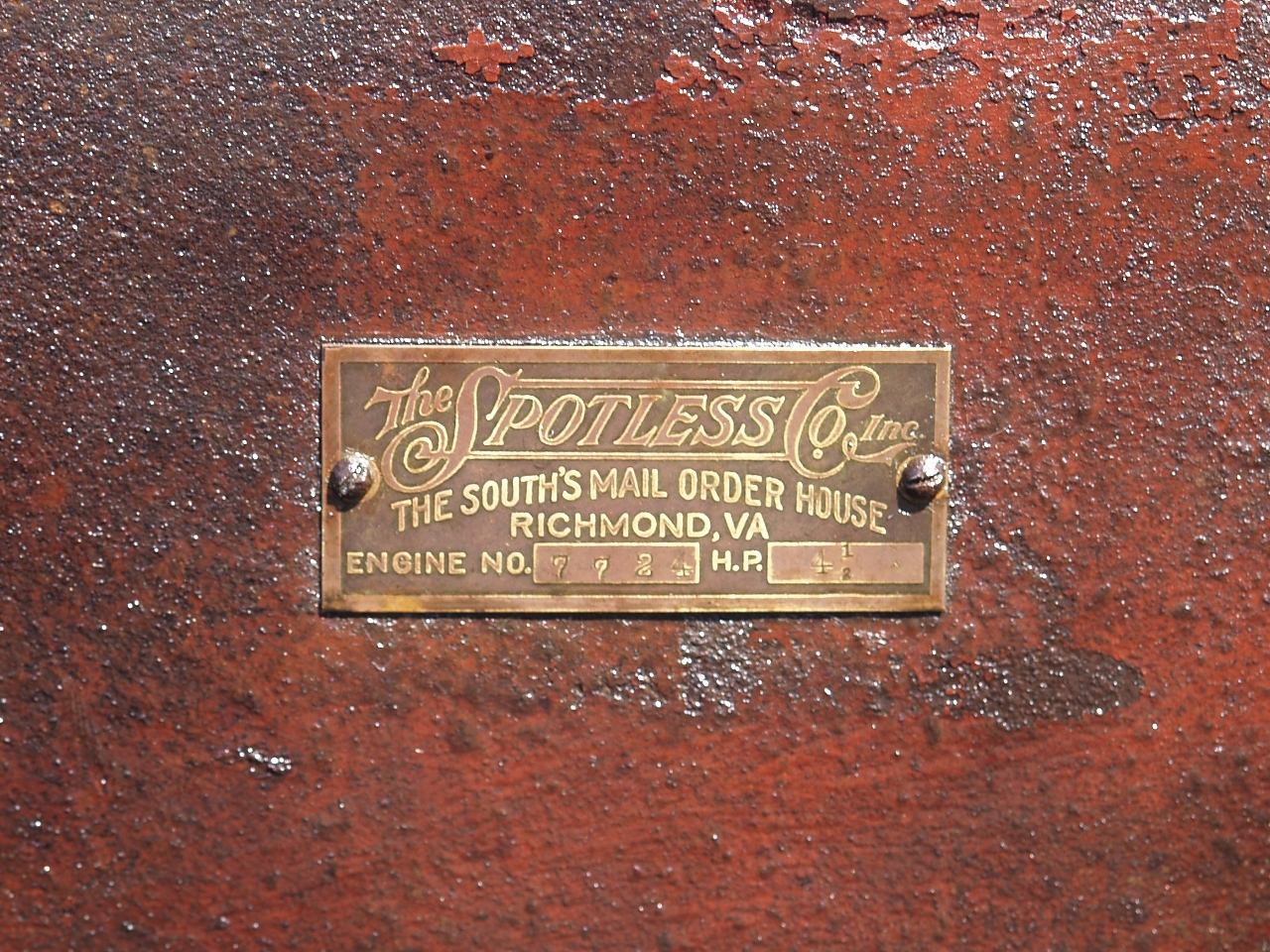
Well, maybe just a smudge here and there. I know that this is a Spotless Engine because it says so, right on the brass badge that’s fastened to the water hopper. “ The Spotless Co. Inc. The South’s Mail Order House, Richmond, Va.” It also list the horsepower as 4 ½ hp. And the engine number as 7724.


So it’s the company, not the engine that’s spotless, or so they would like their customers to believe. Spotless was a regional competitor to Sears and Roebuck that served the greater southeast. One advertisement features a map that shows shipping available to Georgia, Tennessee, Alabama, North Carolina, South Carolina, Virginia, West Virginia and Maryland. Like Sears, they sold almost anything that could be packed up and hauled to your location. The list of their inventory included such diverse items as: farm implements and buggies, barbed wire fence and rubber roofing material, stoves, ranges, sewing machines and organs. 


And engines. In 1912 they offered: 1 ½ hp, 2 ½ , 3 ½ , 4 ½ , 5, 7, 9, 12, 13 and 16 hp. Models. The 5 hp model sold for $115, the 7 hp version brought $146.50. Every engine came with a 5 year guarantee. You had a 30 day trial period to return the engine if you were not satisfied. 


Spotless sold engines but they didn’t make them, like Sears they contracted with a manufacturer to build engines for their house brand. Spotless engines were produced by the Jacobson Machine Manufacturing Co. located in Warren, Pa. They also made engines that were sold under the trade names: Bullseye, Maynard, Moody, Unito and Sturdy Jack Jr. 


An advertisement that ran in a 1914 issue of Tractor and Gas Engine Review boasted that Jacobson made an engine of every type and for every service. Air cooled, oil cooled and water cooled. Hit and miss, throttling and automatic. Stationary and portable engines. Jacobson had you covered no matter what your power needs. 


The 1912 Jacobson / Spotless engine shown here was exhibited at the Western North Carolina Fall Harvest Days Antique Engine and Tractor Show 2018. For information about the 2019 event visit: www.applecountry.org . 


Sources:
www.jacobsonengines.com 
https://books.google.com Tractor and Gas Engine Review 1914 
www.smokstak.com/forum/showthread.php?t=143185 


Monday, July 1, 2019

Rumely 25-45 Type R

The early 1920’s saw a shift in the tractor market, away from the big heavy models to smaller, lighter and most importantly, more economical versions. Rumely had offered lightweights since 1916, but 1924 saw the introduction of four new lightweight models, the L at 15-25 hp , the Type M at 20-35 hp , the Type R at 25-45 hp and the Type S at 30-60 hp.  These models would remain in production into 1927.


In this post we’ll take a look at the Type R, like this example that the Shealy Family brought to the Richland Creek Antique Fall Festival at Saluda, South Carolina in Nov. 2016.


Kerosene was the preferred tractor fuel in the early years of the twentieth century because it was cheaper and more commonly available than refined gasoline but it had its drawbacks. A higher operating temperature was needed to properly vaporize the kerosene but the higher temperature created cooling problems as well. The boiling point of water was too low to be a suitable coolant for a kerosene burning tractor as many a Fordson owner could attest. Rumely solved the problem by using oil as a cooling medium since it boils at 400 degrees F. Think maybe that’s where the name “Oil Pull” came from? 


Rumely shipped a Type R to the University of Nebraska in 1925 where it was evaluated from July 7 to July 14 in test number 116. The following observations were recorded. Brake horsepower for the rated load test was listed as 45.55, drawbar rated at 27.42 hp. Advertised speeds were: low, 2 mph, second, 2 ½ mph, high, 3 mph. Total weight as tested, with operator, 11,900 pounds. 


The R was powered by a Rumely built 2 cylinder, horizontal, valve in head engine with a bore of 7 13/16 inches and a stroke of 9 ½ “. Engine speed was listed at 540 rpm.  The engine speed was controlled by a Rumely built flyball governor. Rumely advertisements claimed it could pull 5 or 6 14” plows or a 10 foot road grader. It came from the factory equipped with a price tag that read, $3200. 


Sources:
Encyclopedia of American Farm Tractors  by C.H. Wendel
https://digitalcommons.unl.edu 


Saturday, June 15, 2019

1924 Crossley Brothers Type 1065 Engine

Imported engines, like this Type 1065 Crossley Brothers, that was exhibited at the 2019 Foothills Antique Power Association of North Carolina Spring show, aren’t something you see very often around here. Judging by the fit and finish shown by this example, they were not inexpensive, even back in 1924. There were dozens of domestically produced engines available that could do exactly the same thing,  that almost certainly cost less.


In 1867 Francis and William Crossley bought a factory that manufactured steam engines, pumps and presses from a man named John M. Dunlop and set up shop under the name of Crossley Brothers. Frank was in charge of factory operations while William  managed the business. It always helps to have a Daddy Warbucks in the family and with considerable help from a rich uncle they acquired the rights to the Otto and Lang atmospheric gas engine for the entire world with the single exception of Germany in 1869. Those privileges expanded in 1876 to include the famous Otto four stroke engine.


Crossley contributed improvements to the engines they manufactured that included poppet valves and hot tube ignition and in 1888 an improved carburettor for using liquid fuels. In 1896 they bought the rights to the Diesel system and by 1901 they were manufacturing gasoline engines for automobiles and buses. In 1906 they expanded again and began building automobiles under the name of Crossley Motors Ltd. During World War 1 Crossley built aircraft for the war effort.. 


The spending spree continued after the war ended with the purchase of the Premier Gas Engine Co. in 1919. Premier specialized in large power plants for ships, railroad locomotives and stationary engines. All good benders must eventually come to an end and Crossley woke up with a serious financial hangover. Now it was Crossley’s turn to be bought out by a company called Bellis and Morcum, who used the Crossley - Premier trademark into the late 60’s. 


The corporate Pac Man game continued as Crossley - Premier merged into Amalgamated Power Engineering, also known as the A.P.E. Group, in 1968. This created A.P.E. - Crossley LTD. Honest, I didn’t make this up. By 1988 Crossley Engines had become a division of Rolls - Royce Engineering who retained ownership up until 2009 when they moved production and closed the Crossley factory in Manchester for good. 


Sources:

www.crossley-motors.org.uk/history/origins.html 
www.grace’sguide.co.uk/crossley_brothers  

Saturday, June 1, 2019

Russell Super Special Grader

Back in February 2018 I did a post about a Russell Junior Grader. Last Summer I spotted this all grown up Russell Super Special, parked in front of the East Suber Road Storage located in Greer, South Carolina. Whenever I stumble across one of these roadside attractions, time permitting, I stop and take a look. I’ve learned a bit more about Russell Manufacturing since that first post, but big gaps of information about the company and its products remain.


Richard Russell and C.K. Stockland set up shop in Stephen, Minn. in 1903 under the name of Russell Grader Manufacturing Co. to build a horse drawn, elevating road grader that they had designed. This machine took the dirt scraped by the blade and conveyed it by belt to a dump wagon or other convenient location. This early product sold well and  Russell continued to expand. 


By 1915 Russell was running front cover advertisements on The Contractor, a trade magazine for contractors that specialized in infrastructure construction. This publication, available courtesy of books.google.com, provides some interesting insights about Russell Manufacturing during that period.


Russell had relocated their general office and factory to 2207 - 2229 University Ave. S.E. Minneapolis, Minn. and had established dealerships in 27 cities in the United States and Canada.  The overseas market for Russell products was developing nicely as well. Graders were being shipped to: Australia, New Zealand, Central and South America, the West Indies, Africa and India.


World War 1 opened up a new market for grading machines. An article that reads like a typical trade publication press release, describes how Russell Vice President, M.T. Nagel had recently sold a “ car load of machines” to the Russian Government, to be used for digging trenches . A photograph shows a Mogul Grader excavating a shallow trench. The accompanying text claims that a mile of trench 4 foot deep can be completed in one hour. The shallow trench produced would no doubt provide protection from rifle fire, but none from airburst artillery shells. The troops who would occupy the sector, had their work cut out for them.   


“For big work, be sure to investigate the Russell Mogul”. The advertisement described the Mogul as, “The largest, heaviest, and greatest capacity road machine made.” The Mogul’s blade was 12 feet long and 20 inches wide and supported by a frame that weighed 6750 pounds. It was intended to be pulled by a 60 horsepower tractor. 


In  descending order of capacity, the Russell lineup included: the Russell Special at eight ft., Russell Standard seven ft., Russell Hi-Way Patrol 6 foot. Russell Jr. at 6 foot and the Russell Kid. 


Russell’s product line also included: dump wagons and the ever popular elevating graders, scarifiers, disc plows, road drags, road plows, railroad plows, snow plows, corrugated galvanized metal culverts and steel beam bridges to name but a few. They also built self propelled motor graders before Russell merged with Caterpillar. 


So where does the Super Special fit into this story? That, I haven’t been able to determine. About all I’ve seen online are a few brief threads on chatroom sites. What made it “Super”? Judging by the other Russell models, my guess would be the size of the blade. With that in mind, I measured the blade on this grader and found it to be nine feet long by 18 inches wide. Since the blade on the Special was given as eight feet, the extra foot would make this one “Super” sized. Of course, I could be wrong.  Any information you, our readers can contribute is always welcome. 


Sources: 

www.constructionequipment.com/russell-grader 
www.smokstak.com 
www.acmoc.org
www.chriscomachinery.com/graderpictures.htm 
https://books.google.com  

Wednesday, May 15, 2019

Ottawa Log Saw

“I saw any size logs, have made good money.”  So said A.G. Drace of  Fenton, Michigan. Mr. Drace didn’t elaborate on how much money, but presumably he had become a wealthy man thanks to his Ottawa log saw.


An advertisement that appeared in the September, 1921 issue of Popular Science Magazine had lots of good things to say, ( no surprise here ) about the Ottawa saws. It was a “One man log saw”, “Easy to move from cut to cut”, “Wheels like a barrow”, “ You start and stop saw blade without stopping motor by simply pulling out the friction clutch.” It was, “Magneto equipped: oscillating magneto ignition. No batteries are ever needed.”  “ Easily operated by man or boy.”


Another ad claimed that you could, “Saw 10 to 20 cords a day.” “Does more than 10 men.” One satisfied customer claimed,”I cut 3 cords an hour with my Ottawa log saw.” It was versatile too. You could use it to run your feed grinder or power your washing machine. Best of all you could own this amazing machine for the low, low price of $39.00 


Ottawa Manufacturing Co. was a division of Warner Manufacturing Company that was formed in 1904 as the result of an offer presented the previous year. A group of businessmen from Ottawa, Kansas approached Warner management about relocating to Ottawa and offered $3000 as an incentive. It seems you could build a new factory for a lot less back in the day, and Warner took them up on the offer.


Warner had been making wire fencing materials since the mid 1800’s but the new factory offered an opportunity to expand the product line. New products would eventually include: mowers, post hole diggers, windmills, gasoline engines and power saws. By 1917 both water and air cooled engines were offered, that ranged from 1 ½ to 22 horsepower. Around 1913 Warner began developing a small engine powered crosscut saw that would become one of their most successful products. 


By the1920’s, Ottawa was a leading manufacturer of power saw products. The drag saw was designed to imitate two men pushing and pulling a saw blade. Powered by a hit and miss engine, the blade could cut at up to 170 strokes per minute. The saw shown here is powered by a 5 hp. Unit that turns over at 550 rpm. 


There is quite a bit of information available online about Ottawa and their products. One of the most interesting that I found is an instruction book for engines and buzz saw rigs from 1918, 1919 and 1920. This manual covers a wide range of topics that are sure to interest collectors and definately owners of an Ottawa saw. Subjects covered include: setting up saw for operation, starting the engine, adjusting the fuel & air mix, setting up the tree saw, how to start a kerosene engine equipped with a magneto without cranking and by cranking, troubleshooting problems and timing the valves. Of special interest to owners would be an exploded diagram and parts list. You can find this interesting document at: www.vintagemachinery.org/pubs/764/5986pdf. 


I photographed # TE 2718E at the Richland Creek Antique Fall Festival at Ward, South Carolina. It is part of the Berry family collection that is on display at the yearly show. For information about the 2019 event visit: www.richlandcreekantiques.com .


Sources:
www.farmcollector.com/equipment/ottawa-drag-saw-zmiz12augzbea 
www.powerofthepast.net/ottawa-engine-company/ The August Reddeman cross cut saw by Brian Wayne Wells , Belt Pulley Magazine 
https://books.google.com Popular Science Sept. 1921 p. 103 


Wednesday, May 1, 2019

Frick 50 - 65 hp Portable Steam Engine

This engine was a late bloomer in the age of steam. I have not been able to pin down the exact dates of manufacture but it was among the last portable steam engines that Frick Manufacturing produced. It is not listed in a 1907 Frick catalog that is available online. In his Encyclopedia of American Steam Traction Engines, Jack Norbeck credits a 1925 Frick catalog for an illustration of this portable engine. That’s as close as I have been able to determine when production began.


Production appears to have continued long after Frick abandoned traction engines. An article in the Nov. / Dec. 2003  issue of Farm Collector magazine states that traction engine production ended in 1936 but portable engines like the 50 -65 hp. Continued to be built until 1938. Other sources say that portable engine production ended in 1932 or simply,during the 1930’s. 


Frick described it as a 50-65 brake horsepower, improved center crank engine mounted on a slab burning return flue boiler that produced 150 psi working pressure steam. The fire box was a cylinder that was 24 inches in diameter that extended the length of the boiler. At the opposite end flue gases entered a smoke box that connected to 2 inch return flue pipes that carried the hot flue gas back through the water jacket again before exiting up the stack. This resulted in a much more efficient heat transfer and higher pressure steam to power the engine. 


The boiler design that it was an improvement on, is often referred to as a “Cornish” type boiler, a design that would span the age of steam. It dates back at least to 1812 when one of the original Steam Punks, Richard Trevithick, no less, installed one at the Dolcoath Mine. If you didn’t sleep through your history classes, you might remember that Trevithick is better known for having built the first successful working steam locomotive. The early boilers lacked the return flues and had only the single horizontal tube that was slightly larger than half the diameter  of the water jacket that surrounded it. They were easy to build and maintain but limited in pressure and steam production.


The design of this engine was perfect for sawmill work in remote locations and that’s the reason that production continued, long after the internal combustion engine replaced steam for most other applications. Even after internal combustion engines could have easily replaced it, it’s hard to beat free fuel, and every sawmill produced that in abundance. 


In the years that Frick was manufacturing steam products they built around 4,500  traction engines. Portable engines cost a lot less and outsold traction engines almost three to one. Around 13,000 portable engines were built before production ended in 1938. 


These engines remained on the job for many years after Frick stopped building them. In fact, the one shown here occasionally still powers a sawmill. It is part of the collection that the Cumming Antique Power Association maintains and they have been known to fire it up to run their demonstration sawmill during the annual show. Of course it’s much easier to back a tractor into the belt than fire up a steam engine and keep it running all day, so don’t be surprised if that’s what you see. You can find more information about the 2019 show by visiting: www.capa-ga.com .


Sources:
www.farmcollector.com/steam-traction/frick-catalog-cuts 
https://archive.org/details/historyoftheFrickcompany 
https://oelectrical.com 
Encyclopedia of American Steam Traction Engines by Jack Norbeck 

Sunday, April 14, 2019

1925 Spoker D

The legendary plow smith was long since departed when management at Deere & Co. decided that they needed to be in the tractor business. R & D work began in 1912 and continued until 1921. With thousands of hours of labor and truckloads of cash expended and nothing that was marketable to show for it, they concluded that the best way to get a tractor they could sell was to buy one. In 1918 Deere bought out the Waterloo Gasoline Engine Company and acquired the rights to the already popular Waterloo Boy tractor for a cool two million dollars. Deere marketed the Waterloo Boy Model N until 1924.


In 1924 Deere introduced the first John Deere tractor, the Model D. It would prove to be one of the most successful and longest production runs of any tractor ever  built. Apparently they learned a thing or two from the Waterloo Boy.  Production began in 1923 with the earliest tractors sold as 1924 model year tractors. A total of 160,000 units were manufactured before the D tractors were superseded in July 1953. With a price tag of $1000 in 1924, they were not cheap tractors, especially during the lean years of the Great Depression. 


Serial numbers began at 30401 for 1924 and ran to 31280 at the start of 1925. 1925 tractors included those numbered up to 35309 when 1926 production began. Unstyled model Ds were built up until 1938 with serial number 138413 being the first tractor built that year. 1939 saw the introduction of the styled tractors with the streamlined look. Styled Ds run from 1939 to 1953, 143,800 in in 1939 to 1953 when 191,439 began that year.


There were other variations besides the styled vs. unstyled. Solid flywheels are quite common but you seldom see a spoked flywheel. One source I consulted claimed that only the first production year tractors had spoked flywheels. There were also three separate stack versions, no stack, ( like the one shown here ) , one stack and two stack models. The no stack version was the early one with serial numbers ranging from 30400 to 53387. Listening to the bark of the exhaust no doubt made for a long day on the driver’s seat, so by SN: 53388 the first stack had been added. At number 109944 the second stack made its debut.  One final note about serial numbers. Tractor numbers 31321 to 31412 are not model Ds at all, according to tractordata.com. These were Waterloo Boy Model N tractors that were built after the Model D production had begun. 


Some have said that the early model D’s were just rebadged Waterloo Boy tractors. That position is given support by the Nebraska Tractor Test report number 102 from April 1924.  On that report the manufacturer is listed as Waterloo Gasoline Engine Co. of Waterloo, Iowa. That’s not too surprising since that is what is cast in iron on the tractor, right in front of the operator’s position.  


The two cylinder, horizontal, valve in head engine, was similar to those powering the earlier Waterloo tractors. With a bore of 6 ½” X 7” stroke they displaced 465 cubic inches making them slightly larger and more powerful than the Waterloo engines. The fly-ball governor kept engine speed at the rated 800 rpm. Drawbar pull was rated at 16.75 hp. Belt power was recorded at 27.11 hp. The enclosed, chain drive transmitted power through a disc clutch to produce two forward speeds; low - 2.45 mph. High - 3.27  mph. 


The Spoker D shown here is part of the Berry Family collection. I photographed it at the Richland Creek Antique Fall Festival held annually in early November at Ward, South Carolina. To learn more about upcoming events visit: www.richlandcreekantiques.com . 


Resources:

https://americanhistory.si.edu 
Encyclopedia of American Farm Tractors by C. H. Wendel
www.hemmings.com 
Steiner Tractor Parts Catalog 2017 ed.
www.retiredtractors.com 
www.tractordata.com 
Digitalcommons.unl.edu 


Monday, April 1, 2019

Shaw Du-All Model N 8 Garden Tractor

What did Elgin watches  and this Du-All tractor have in common? Answer: Stanley Wilbur Shaw.


Shaw was another of those talented tinkerers that seemed to be everywhere in the late 19th and early 20th centuries. Legend has it that he built his first steam engine at an early age, but said legend doesn’t elaborate on how successful or practical that engine turned out to be. By the dawn of the Twentieth Century he was operating a watchmaker’s  shop in Galesburg, Kansas where he sold Elgin watches and a couple of other brands. In 1902 he developed a gasoline engine and by 1903 he had established Shaw Manufacturing Company to build them. In 1905 he patented a small gas engine to convert a bicycle into a motorbike. The conversion kit met with a degree of success and he sold 13,000 of them. 


Stanley plowed much of the profit back into his company and expanded the engine line to include air and water cooled stationary and marine engines. In 1908 the Shawmobile entered the  rapidly expanding automobile marketplace. 1923 saw the introduction of a conversion kit to turn the farmer’s Model T Ford into a tractor. Conversion kits were still being offered in an ad placed in Popular Mechanics magazine in February 1932. The ad copy read in part, “Make a tractor from your old car.” and “Anyone can attach Shaw equipment quickly and easily using only a monkey wrench and a screwdriver. You don’t have to be a mechanic.”


Now we get to the meat and gravy part of the story. In 1928 Shaw Manufacturing offered a motorized lawn mower. Sometime around 1932 or 33 a walk behind cultivator and a garden tractor version called “The Happy Gardener Du-All” was introduced. This developed into the walk-behind D series that was available in five horsepower ratings; D2, D3, D4, D5 and 2D5, the number corresponding to the horsepower. Briggs & Stratton provided the motive power for all models which proved to be a good thing for Briggs because Shaw Mfg. was ordering a boxcar load of engines per week. 


1938 saw the introduction of the riding tractor version with the RD model available in 3, 4, 5, 6, 7, and 8 horsepower options, designated as RD3 etc. The Du-All tractor line lived up to its name with a full line of accessories being available. Attachments included: sprayers, a 12” moldboard plow, 20” disc plow, 10” X 16” disc harrow, cultivators, 5 ft. cutter bar, 6 ft. cutter bar, 10’ hay rake, bulldozer blade, trailers, potato diggers, hydraulics for attachments like loaders and power saws. There is even a photo in the 1953 catalogue of a Du-All pulling an  8’ International Harvester Combine. 


So where does the Model N 8 fit in this picture? The short answer is,  I don’t have a clue. The only reference to it that I could find was a very brief comment on smokstak.com that the original power source was a Briggs 23 8 hp. Engine. There is no mention of an N model in the 1953 Du-All  catalog provided courtesy of oldirongardentractors which by the way, is a site worth visiting by anyone interested in these tractors. 


According to David Beattie in his Gas Engine Magazine article, Shaw sold the company to Bush Hog in 1962 and Bush Hog discarded a large portion of the information that was then available  about Du-All products. N 8 documents may well have been among the victims of this purge.  If anyone can provide more information, your comments would be welcome.


The N 8 shown here was exhibited at the 2018 Steam Expo in Cumming, Ga. No information was displayed about this tractor. To learn more about the show that will be held on Nov. 8, 2019 visit : www.capa-ga.com . 


Sources:

www.gasenginemagazine.com  Shaw Manufacturing Company History by David Beattie , Aug / Sept. 1997 
https://oldirongardentractors.files.wordpress.com/2018/05/shaw-catalog-no-25-compressed.pdf 
www.smokstak.com 
Books.google.com Popular Mechanics Feb. 1932 P. 141