Sunday, April 15, 2018

John Deere Model 420 Crawler Tractor

Deere & Company was a Johnny come lately to the track layer market. It was the early 1940’s when they sent some GP model tractor frames to the Lindeman Brothers in Yakima, Washington for developmental work on a Deere crawler. The experiments that followed resulted in the Model B Orchard version Crawler; so loved by collectors today. Deere bought out Lindeman in 1947 and in 1949 introduced a crawler version of the Model M that was built at factories in Dubuque, Iowa as well as the Yakima location. More than 10,500 copies of this crawler rolled off the assembly lines.


The 40 C models were next with production beginning in 1953 and continuing until 1955. A total of 11,689 examples of this version were sold. In 1956 the 420 crawler superseded the 40 model which brings us up to the tractor featured in this post.  


Production of the 420 crawler spanned the the years from 1956 to 1958 during which time a total of 17,882 were produced, all but 92 of which were gasoline engine powered. For some reason Deere referred to them as belonging to phase 1, 2 or 3; the phase corresponding to the year built. The 1956 phase used a 40 model engine block that had been bored out by ¼” to 4 ¼” X 4” for a boost in horsepower that also boosted temperature. The 40 had a thermosyphon cooling system which proved inadequate so a water pump was required to deal with the extra heat. The engine block casting was modified to accommodate the added water pump for the 57 model production phase and a five speed transmission was offered as an option. Phase three units had more minor engine modifications and cosmetic alterations that involved changes to the dash and the steering mechanism. 


The 420 series was produced in a variety of configurations that included: S - standard model, T - tricycle, U - utility, W - row crop utility, H - hi-crop, I - industrial and C - crawler version. All together a total of 46,450 units were sold. The crawler version was advertised as a 3 or 4 plow tractor with speeds listed as: first, ⅞ mph. Second, 2 ¼ mph. Third, 3 mph. fourth , 5 ¼ mph. Reverse, 1 ¾ mph. It was available as a 4 roller model weighing 4150 pounds or as a 5 roller weighing 4700 pounds. 


The 1958 price quoted varies according to the source you consult  ranging from $2316 to $3267. This example offered for sale at the 2017 WNC Fall Harvest Days Show had a sticker price of $4000. After fifty nine years of hard work, I’d say it has held its value pretty well. 


The 420 C was evaluated at the University of Nebraska - Lincoln in Test Number 601 from October 15, to Oct. 25, 1956 with the following specifications noted. Engine: John Deere vertical 2 cylinder with 4.25” bore x 4” stroke displacining 113 cubic inches. RPM 1850. Maximum observed horsepower 23.53 drawbar, 28.76 on the belt. Total weight, 5079 pounds. 


Sources:
www.keepemcrawling.com
www.johnnypopper.com 
www.johndeere40.com 
www.lindemanarchives.com 
University of Nebraska - Lincoln Tractor Test 601 

Sunday, April 1, 2018

Panzer Attack, 1959 Model T 50

Inquiring minds want to know, “ What does COPAR stand for anyway?”. In an article published in Farm Collector Magazine in May 2013 titled The Panzer  tractor through the years, Sam Moore offered the following explanation.


On a sweltering summer day in the early 1950’s James Clark was toiling in his yard under a blistering sun trying to control a walk behind garden tractor when he had one of those revelations common in such situations. Suddenly, he realized that he wasn’t enjoying what he was doing, at all! Being an engineer by profession he started looking for a solution to the problem. After trying several of the riding tractors available at the time he decided that he could design a better one and before long he approached the management of the company where he worked  with his ideas for a new riding garden tractor. 


Ahrendt Instrument Company of College Park Md. was primarily a defense contractor with no experience or connection to the lawn and garden industry whatsoever but they liked what Clark presented and surprisingly gave him a green light to develop his project. By 1954 they were in the garden tractor business and expanded into a renovated factory  in Laurel, Md. early in 1955. The first Panzer was a three wheel design powered by  a eight and a half horsepower Briggs & Stratton engine. It sold well and the product line soon expanded. 


By 1957 they decided that a smaller Panzer was needed and introduced the T 50 Model. It was powered by a four horsepower Clinton Model A 1200 engine that developed a reputation for vibration and being hard to start. The fact that the engine was bolted directly  to the frame only made matters worse. Some T 50’s were equipped with a Kohler K 90 4 hp. Engine that may have been an attempt to address the vibration issue. The T 50 production run turned out to be a short one. By late 1958 it had disappeared from COPAR sales literature. A flyer from that year listed a Model T 55 with a 4 hp Briggs & Stratton and a Model T 60 with a 5 ¾ hp Briggs but the T 50 was gone, never to return. Copar continued small tractor production with the T65 model until 1960 when small tractors were permanently discontinued.


Virginia Metalcrafters bought the Copar production facilities from Ahrendt in January 1960 . Three years later they acquired the Pennsylvania Lawn Mower Co. and combined them into the Pennsylvania Lawn Products Division. At this point the COPAR name was dropped and the tractors became Pennsylvania Panzers. Paint colors also changed  from red with yellow wheels to blue with white wheels and the tractors became “ Pennsylvania Panzers”. Production continued as Pennsylvania Lawn Products until 1970 when Schenuit Industries bought them out. One year later Schenuit went bankrupt and Pennsylvania Products was shut down for good.


The Model T 50 shown here is owned by Scott Ogle and was exhibited at the 2017 Fall Harvest Days Antique Engine & Tractor Show at the WNC Agricultural Center - Fairgrounds near Asheville, NC. Oh yea, about the name, almost forgot! COPAR is an abbreviation of College Park. When the first tractors were ready to go into production, Ahrendt held a name the tractor contest for the employees at the factory. The winner was, you guessed it, Panzer.


Resources:
www.farmcollector.com
www.tractordata.com 
www.panzertractors.com 


Thursday, March 15, 2018

Peerless Portable Steam Engine

Early in 2017 the members of the Foothills Antique Power Association of North Carolina installed this seven horsepower Peerless engine display in the back room of their General Store building at the Hickory, NC. American Legion Fairgrounds. The engine is owned by the Conrad Moretz family and is on semi- permanent loan to the F.A.P.A. for the display. It appears to be powering an overhead belt drive power transmission system like those in use in most mills and manufacturing facilities of the period and the visitor can watch the engine’s machinery in action. The effect is quite convincing until you realize that there is no heat radiating from the boiler and you take a closer look for signs of a fire behind the firebox door.


The exact year for this engine isn’t given but it probably dates to the early 1900’s. Cast into the metal of the smokebox door on the front of the engine is a patent date of April 13, 1875. A search will turn up a Scientific American from March 30, 1878 courtesy of books.google.com . Here you will find an illustration of the “new Peerless Portable steam engine, 6 to 10 hp.” that looks similar to the engine shown here. 


Peter Geiser founded Geiser Manufacturing Co. in 1855 to sell  threshing machines of his design. He moved production to Waynesboro, Pa. in 1860. Apparently George Frick offered him part of the land he had purchased to build his factory on. It wouldn’t be long before Geiser Mfg. Co. was producing Peerless steam engines to compete with Frick Eclipse models. Emerson-Brantingham Co. bought out Geiser in 1912 but continued to use the Peerless / Geiser name for a number of years. The sources that I have seen agree that Emerson Brantingham acquired the Peerless line in 1912 but beyond that, accounts vary.


The most accurate and complete version of the story might be the one you can find at www.emersonbrantingham.com . This site has done yeoman’s work of assembling and making available online a collection of original source material on the subject. According to their history, EB went on an acquisition binge in 1912 gobbling up other companies like some crazed corporate Pac Man. The list included: The Pontiac Buggy Co. , LaCrosse Hay Tool Co. , Reeves and Co. , Geiser Manufacturing Co. , Rockford Gas Engine Works, Gas Traction Co. ( Big-4 ), Newton Wagon Co. , and American Drill Co. All this in one year! Like most benders, this one left a serious hangover in its wake and Emerson Brantingham found itself facing major financial difficulties. 


Emerson Brantingham had added two major manufacturers of steam engines and a producer of large heavy tractors to their portfolio, just as the demand for these products was beginning to decline. By 1928 it was EB’s turn to be acquired. J.I. Case of Racine, Wisconsin moved in and bought up what was left, mainly for the manufacturing facilities.


One of the documents you can download at the emersonbrantingham.com website is a Geiser Machinery Catalog from 1913. The forward contains the announcement that since the issue of the last catalog, the Geiser Works had become a part of the Emerson- Brantingham Organization. This catalog features illustrations of nine traction engine models, a line of threshers, hullers and separators for a variety of crops, accessories , water wagons and road rollers. Page 45 features an illustration of a Peerless Portable engine typical of engines from 4 to 15 horsepower. The copy states that larger engines were available from 20 to 35 hp. Hay presses, sawmills and gas engines were also offered that year. This catalog is just one of a number of interesting documents available at this website. Check it out.


The F.A.P.A. annual show will be May 18th and 19th 2018 at the Hickory American Legion Fairgrounds in Newton, NC. for more information click the link in the shows and events section, or do it the hard way by typing www.foothillsantique.com into your browser. Still have questions? Call the show chairman, Teddy Hefner at 828-310-5525.


Additional resources:
Encyclopedia of American Farm Tractors by C.H. Wendel
Encyclopedia of American Steam Traction Engines by Jack Norbeck

Thursday, March 1, 2018

1932 Massey-Harris GP 15-22

It must have seemed like a no-brainer at the time. If two wheels pulling is good, all four of them pulling has to be twice as good. Right?  Unfortunately, the Massey design team chose to ignore two of the immutable laws of nature, the K.I.S.S. principle and Murphy’s Law. The result was predictable.


Massey-Harris certainly wasn’t the first to build an all wheel drive tractor and they wouldn’t be the last. The concept may be sound but the devil lies in producing results that are measurably better and this was where the GP fell short. Try as they might, Massey’s engineers just couldn’t manage to pull more drawbar performance out of it than some of the competition managed with two wheels.


Introduced in 1930 the GP was rolled out just as the Great Depression was beginning to take its toll with production spanning the lean years until 1936. It was a time when farmers were in no mood to try something new, especially when popular competitors like the Fordson and the Farmall were available, usually at a lower price. Sales remained disappointing throughout the production run with only 3000 tractors sold at $1000 per copy.


It’s obvious that a lot of engineering went into this tractor. Every part on it serves a purpose, all muscle and bone with not a bit of fat anywhere. Beneath the gas tank that doubled as a hood lay the four cylinder 226 cubic inch Hercules power plant that connected through a three speed transmission to a transfer case and differential for each axle. A belt pulley and a rear PTO offered power transfer. Electric lights and starter along with an implement lift were offered as an option. A metal seat provided the only concession to operator creature comfort. It was a lean machine to be certain.


Massey sent the GP to Nebraska in 1930 where it was evaluated in test number 177 from May 5th  to May 27. It managed a highest rating of 15 drawbar horsepower and 22 hp on the belt. Notes for the test indicate that no repairs or adjustments were required. Apparently Massey management was looking for a higher rating because they sent it back one year later when it underwent test number 191  from May 22nd to June 12, 1931. This proved to be a mistake because the best this tractor could manage was 13.02 hp drawbar and 20.31 on the belt. As if that wasn’t bad enough a number a parts failed and required repair or replacement during the course of the test. It clearly wasn’t what Massey had hoped for. 


The GP measured 119 inches long, 55” high and cleared the ground by 30”. Front and rear tread options were: 40”, 60”, 66” and 76”.  The tractor weighed in at 3900 pounds. Turning radius was six feet. Serial numbers began at 300001 in 1930 and ran to 303001 in 1936. 


The 1932 model shown here is owned by Dave and Pat  Kari who brought it from Minnesota to the 2017 Fall Harvest Days Antique Engine and Tractor Show near Asheville, NC. for the Massey Expo of North America 2017. Many thanks to them for contributing this interesting bit of history to the event. 


Sources:
University of Nebraska Tractor Test Reports number 177 and 191.
www.mfpartsonline.com 
The Big Book of Massey Tractors by Robert N. Pripps at books.google.com 

Thursday, February 15, 2018

Minneapolis-Moline Model BG 1 Row

Minneapolis - Moline was the product of a 1929 merger of the Moline Implement Co. , the Minneapolis Threshing Machine Co. and the Minneapolis Steel and Machinery Co.  All of these were established businesses, the Moline Implement Co. dated back to 1870. Minneapolis Steel manufactured the popular Twin City tractor brand. The newly formed company soon established itself as an innovative leader of the industry. All things considered, there ought to be a ton of info online about M-M products. Right?  Wrong!


Information about the Model BG tractors is especially hard to find. This may be due to the limited number of this model produced. Tractordata.com ( which supplied most of the material I could find ) places total production at 1200 tractors made between 1953 and 1955. Steiner’s parts catalog has a list of serial numbers that runs from 1953 up to the first serial number of 1956 that adds up to 937 units. Not very many either way. How many of these have survived to the present day is anybody’s guess.


Those numbers make the fact that two of these tractors made an appearance at the Richland Creek Antique Fall Festival in Saluda, SC. last November pretty remarkable.


Davis Cromer brought his 1953 model.  Steiner’s serial numbers indicate that 1953 was the model’s best year with 600 tractors produced. 


This 1954 edition is owned by Ben Merchant and is one of only 168 units that were manufactured during the second year of production.  Why the steep drop in production? Of course the dealerships could have still been sitting on an inventory of unsold 53 model tractors. 


A four cylinder 133 cubic inch Hercules 1X3SL gasoline engine turning at 1800 rpm powered the BG. Belt horsepower was claimed to be 27 hp. 


The transmission provided four forward gears plus reverse. 


The wheelbase on the BG measured 75”.  Ground clearance was 20.5”. The tractor’s weight is listed as 2880 pounds.


Thursday, February 1, 2018

Russell Jr. Road Grader

When I saw the Russell name cast into the gears on this pull grader I assumed it was another product of the C. M. Russell Company of Massillon, Ohio, makers of steam engines, among other things. As it turns out however, the only thing the Russell Grader Manufacturing Company of Minneapolis, Minnesota had in common was the name Russell.


In 1903 Richard Russell and C. K. Stockland formed a company specifically to build a horse drawn road grader in Stephen, Minnesota. They soon relocated their factory to Minneapolis, Minn. and expanded their line of road grading equipment but as far as I have been able to determine road graders were the only product they manufactured.


During the twenty-five years of its existence the company produced a range of graders to meet a variety of needs. The Russell JR. fell somewhere in the middle of the product line between the Mogul with a twelve foot blade and intended for use with a 25 HP tractor and the Russell Gem, equipped with a five foot blade operated by one man and pulled by two horses. 


In an advertisement in the North Carolina Highway Bulletin Vol. 2 , The state distributor for Russell graders , E. F. Craven of Greensboro, NC. “ The Road Machinery Man” wrote: “ For those who are willing to put four horses and two men on the grader, the Russell JR will do maintaining work more effectively than any other grader. This machine has a 6 foot blade and may be used for light road construction as well as maintenance work.”   


Russell catalogs and sales brochures from the period also included : the Russell Reliance with a 10 ft. blade, intended for use with a 20 hp. Tractor, the Russell Special an 8 foot machine paired with a 15 hp tractor, the Russell Standard with a 7 ft. 3” blade for use with eight horses or an 8 to 15 hp. Tractor, the Russell Hi-Way Patrol a 6’ machine for 2 horses and one man operation,and  the Russell Kid, another 2 horse machine. 


1920 saw the introduction of a self propelled grader they called the Motor Patrol. This machine consisted of an Allis-Chalmers tractor with a grader frame built around it. In 1926 Russell built a crawler version of the Motor Patrol that used a Caterpillar tractor as the power source.


In 1928 Caterpillar Tractor Co. acquired Russell Manufacturing and incorporated it into a Road Machinery Division that built road grading equipment. 1931 saw the introduction of the Auto Patrol  model, described as being the first of the modern graders. 


The grader shown in these pictures is on display at the Polk County Museum at 60 Walker St. in Columbus, NC. just a few blocks down Hwy. 108 from Interstate 26. For more information about the museum visit: www.polknchistory.org 


Resources:
Catalog and brochure illustrations of Russell graders can be found at several websites:
www.chriscomachinery.com 
https://olddesignshop.com 
Books.google.com list an ad that appeared in  the North Carolina Highway Bulletin Vol. 2
An ad for Russell road machinery that ran in The American City in 1914 on sale at www.ebay.com 
Info. about Russell Grader Manufacturing Co. at  www.caterpillar.com 


Sunday, January 14, 2018

Gard'n Mast'r Garden Tractors

 Searching the web for information about Gard'n Mast'r garden tractors leads to the conclusion that these are rare collectables indeed. There certainly isn't much online about them and the Gardenall Tractor company that built them seems to have been sucked into one of those memory holes that nothing ever escapes from. What you mainly find are request for information about them posted on various collector chat rooms that begin like, " Has anyone ever heard of a Gard'n ....".  In keeping with tradition no information was posted on these examples that were on display at the Steam Expo. last November so I can't relay that either.


Books.google.com has posted a couple of classified ads that supply a little bit of insight. On page 271 of the July, 1949 issue of Popular Mechanics magazine an ad for the company's two wheel walk behind tractors appeared. It illustrates the sickle bar mower attachment that was offered in 30", 32" and 36" width versions. It goes on to say that four models of the tractor were offered with prices starting at $159.50 . The April, 1952  issue also carried an ad for Gardenall products on the bottom of page 308 right next to an add for the amazing " Electro-Tube, a powerful, precision aerial intensifier", a gizmo that looks like something George Jetson would have on the radio antenna of his flying saucer. The Gardenall copy states that five models of the 2 wheel tractor were available ranging from 2 to 4 1/2 hp, " A model for every possible requirement." An eight horsepower Gard'n Mast'r is also illustrated. The company offered a line of attachments for "every year round need." according to the advertisement.


The most information about these tractors that I was able to find comes from a sales brochure provided by oldirongardentractors.com  that gives details about the 8 hp Gard'n Mast'r and the 6 hp Model JR. In addition to the walk behind tractors the company manufactured a respectable number of accessories for use with these riding tractors. The list included 8" plows for the JR and a 10" plow for the Model G, a furrower frame and shovels for both, 36 and 42 inch disc harrows, cultivators, a right angle power takeoff for both models, sickle bar mowers, tow behind gang mowers with 3 20" wheel powered mowers, a dump trailer and utility scraper blades.


The Gard'n Mast'r was available with a choice of engines. A Brigg & Stratton model 23 with a 3" bore and 3 1/4 " stroke displacing 22.97cu. in. producing 8 hp at 2900 rpm. or a Wisconsin AEN with identical displacement but a claimed 8 1/2 hp at the same rpm. The transmission provided three forward speeds: low 2.54 mph, second 4.10 mph, high 6.5 mph, reverse 2.35 mph.


Specifications for the Model JR: Engine: Wisconsin Mod. AKN - 6 hp. Transmission: 3 forward speed plus reverse. Clutch: Hand operated Rockford disc type. Wheel base: 54". Tread width: 26". Weight: 700 pounds. Color: Jade Green with red trim.


All three of these tractors have a Gard'n Mast'r decal on the hood but provide no further information.


Monday, January 1, 2018

25-75 Russell Traction Engine


Where there’s smoke, sometimes there’s steam and the engine shed at the Cumming, Georgia Fairgrounds during the annual Steam Expo. is the best place around here to find it.


Buddy Castleberry was busy stoking the boiler on his 25 HP. Russell Engine at the 2017 Show when I wandered by. He says that getting the engine ready to run is the hardest part, even more work than cleaning it after it’s shut down. He should know, he grew up running this engine that’s been owned by the Castleberry family since 1925.


Engine number 15516 was ten years old when the Castleberry family bought it. A list of serial numbers posted at www.russellcollectors.org indicates it was built in 1914 with production beginning at 15370 and ending at 15648. At first it was used to power a portable sawmill that was hauled to the location where trees were being felled. A buzz saw was attached to a shaft that was supported by the engine’s frame and powered by a belt drive. Later on it was used to run a cotton gin and as a general power source around the farm. It’s been participating in Forsyth County steam events right from the beginning back in the 1950’s.


Russell and Co. dates to 1838 when Clement and Nahum Russell opened a carpentry shop in Massillon, Ohio. In the early years they built houses, made furniture, plows, threshers and other farm equipment. They constantly expanded their product line making everything they could find a market for from caskets to railroad cars.


By the time the company incorporated in 1878 it was one of the largest employers in Massillon, playing a major role in the local economy and marketing products around the world. They got into the steam engine business in 1882 and by 1924 had built 15,882 of them ranging from six to 150 horsepower in traction engine, portable and stationary versions. Other products included water wagons to supply the engines, threshing machines and sawmills for the engines to run. The company even made a brief appearance in the overcrowded gasoline tractor market.


A Russell and Co. catalog published in 1914 offered simple and compound engines in their traction engine line with standard or universal boiler options. Threshing machines, portable engines, stationary engines and saw mill machinery were available as well.


The 1914 catalog gave the following specifications for a 25 - 75 HP traction engine.

Overall length: 18’ 6”

Weight of engine without water: 22,300 pounds

Water tank capacity: 125 gal.

Boiler shell: 32” in diameter by 90” long containing 50 tubes 2” in diameter

Firebox dimensions: 49” long X 26” wide X 44 ⅛” high

Engine cylinder: 9” X 13”


Road speed: 2.11 mph


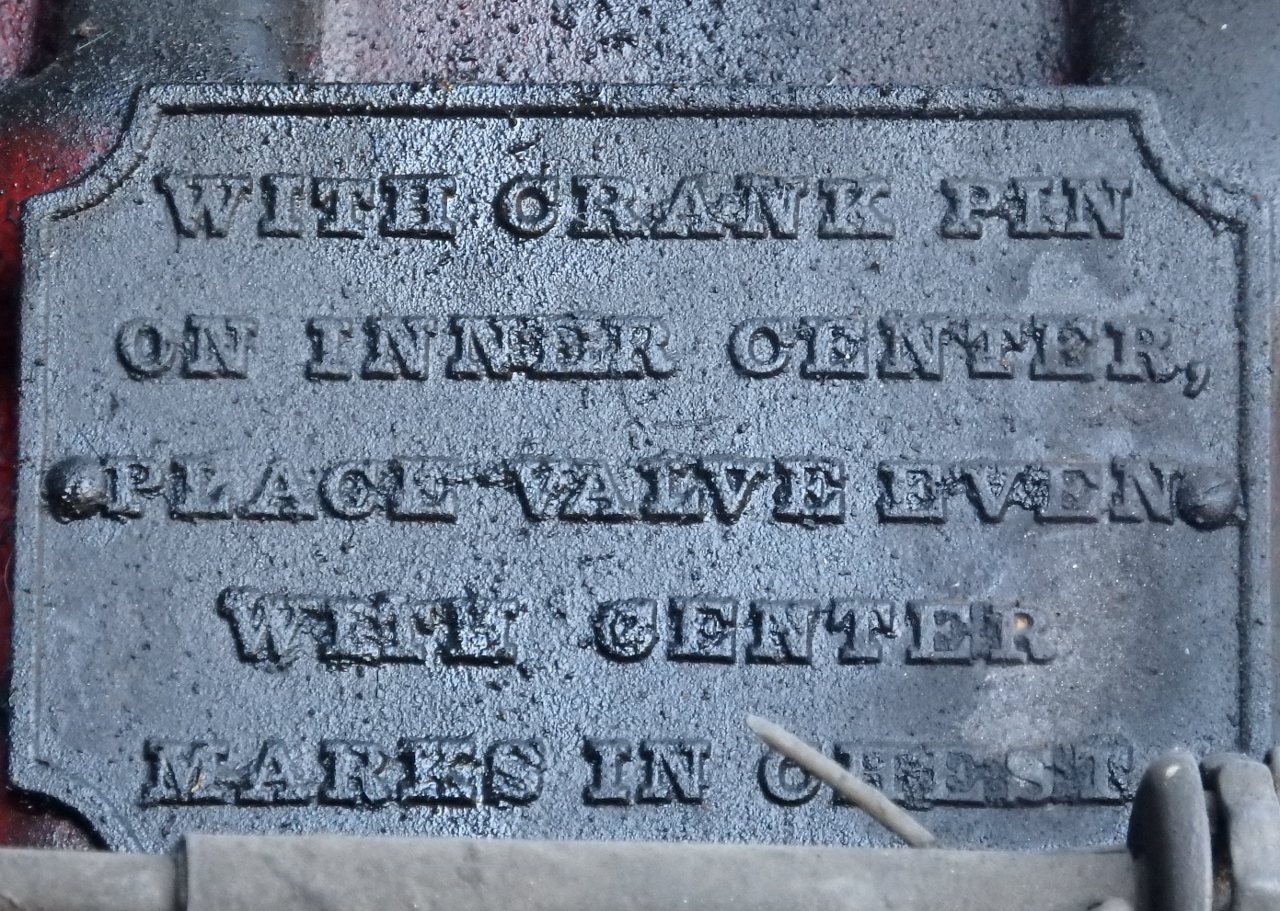
As this photo illustrates the Russell Company was very concerned with proper maintenance procedures. Engines came with instructions cast in iron and riveted in place.


Many today consider the Russell steam engines among the best ever built but apparently the company didn’t successfully manage the transition away from steam power. In 1912 it merged with Grissom - Spencer Company and continued under that management until 1962 when it was bought by Baldwin - Lima - Hamilton Co. who closed the Massillon Works and laid off 10% of the towns workforce.


Resources:


The Massillon Museum has posted a collection of documents about Russell & Co. including Russell Catalogs at their website: www.massillonmuseum.org


The National Russell Collectors Association provides a list of serial numbers, information about the history of Russell & Co. and links to other sites of interest at their website: www.russellcollectors.org