Wednesday, March 15, 2017

Port Huron Engine Number 6166


“I remember that engine as though I had seen it only yesterday, for it was the first vehicle other than horse drawn that I had ever seen.” Henry Ford


If you visit www.thehenryford.org you can find a photo of a 1916  Port Huron Traction Engine in the museum’s collection that very closely resembles this 1914 model. So was it a Port Huron Traction Engine that inspired a young Henry Ford to create his Model T in 1908? We may never know. After tossing out that intriguing quote the very brief article wanders off to other pastures. Ford was a Michigan native but the Upton - Port Huron Traction Engine Company made its first engines in 1882. Ford would have been 19 years old at that time.
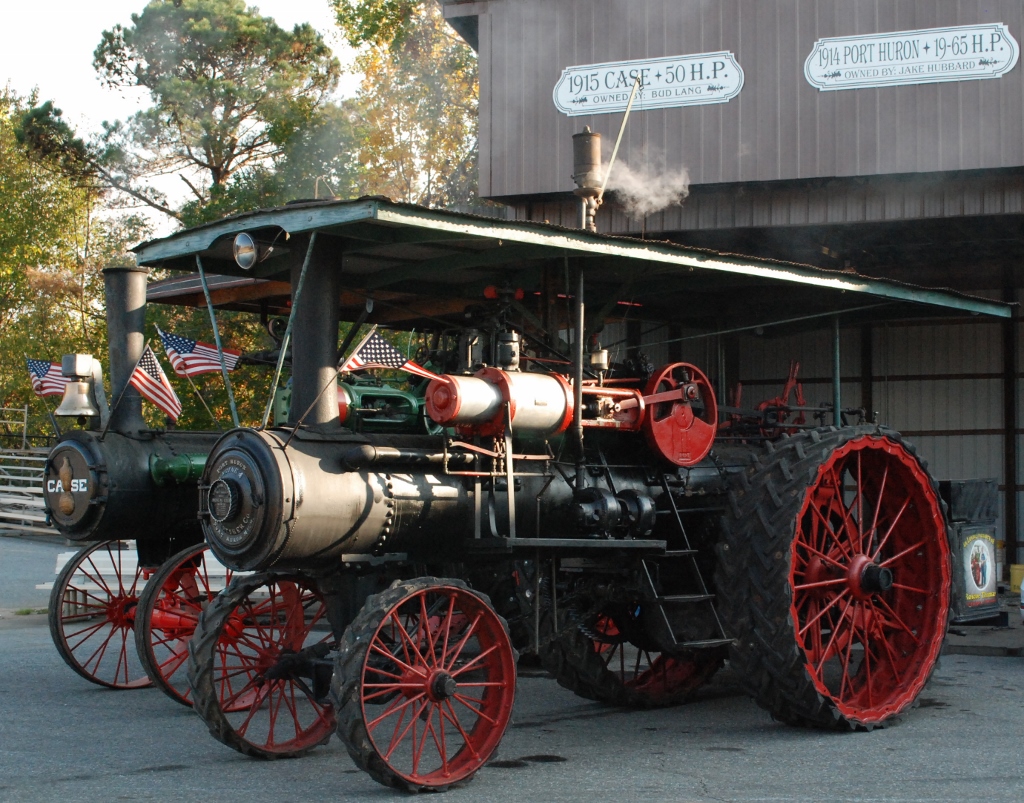


Engine number 6166  was making steam at the 15th Annual Cumming Steam, Antique Tractor and Gas Engine Expo. Nov. 11 & 12 2016. Like the one at the Ford Museum, this one,owned by Jake Hubbard, is a 19 / 65, 19 hp on the drawbar and 65 hp on the belt.


Jack Norbeck in his Encyclopedia of American Steam Traction Engines states that the Port Huron-Woolf Compound engines were the best ever developed for threshing due to their economical and reliable operation. Port Huron claimed that their compound engines reduced fuel consumption by 3 to 4 percent compared to other engines.


In essence the compound engine achieves its economy by using the same steam twice. High pressure steam is admitted to the first cylinder then exhausted into another cylinder where it continues to expand, thereby wringing more work out of the fuel and water consumed.


Surf on over to https://www.midwestagmuseum.com/1919-port-huron-thresher/  to checkout the 1914 Port Huron sales brochure they have posted on their site. Within the first twelve pages you will find a series of very nice illustrations of the traction engine line they offered that year: A 16 hp compound,  20 hp “Longfellow” simple, 19 hp “Longfellow” compound, 24 hp “Longfellow” compound, 32 hp compound engine; and that’s just the beginning of the good stuff. Keep turning pages for cutaway diagrams of boiler construction, firebox and boiler tube details, boiler specifications and more. There’s even a cutaway illustration of the Port Huron - Woolf Compound Engine and a detailed explanation of the operation of the slide valve of this engine.


Port Huron claimed that the extended length of the tubes in their boilers made more efficient use of fuel because less heat was wasted up the stack, and that the 28” to 30” smokebox provided a measure of safety by reducing sparks and embers escaping with the exhaust. This extended length of the boiler was the origin of the name Longfellow.


The company was also quite proud of the construction of their operator’s platform, claiming that it could support the weight of the entire rear end of the machine, thus saving many lives and engines. A photograph of an engine that has collapsed one of the rudimentary bridges of the period is included on page 29 and sure enough, the platform is the only thing holding up the back end of the tractor. Since the 19 hp engine weighed in at 17,200 pounds, this was probably not an unusual occurrence.


Wednesday, March 1, 2017

Caterpillar Model 44 Pull Grader

A favorite to do on this blog is posting old iron that’s in search of a new home.


I had driven by this location a number of times without noticing this old pull grader because it has only recently been recovered from the vines and weeds that had completely engulfed it. Makes you wonder how many other antiques might be lurking under mounds of vegetation out there.


The plate on this machine identifies it as a Caterpillar, Grader # 8H770 but no model  is listed.


The best source of information about Caterpillar pull graders that I have found is at www.chriscomachinery.com/pullgraders.htm . The list of graders here identifies the 8H designation as belonging to the 44 and 30LW group, manufactured between 1937 to 1942.


Some specifications that might be of interest to a prospective buyer; weight: 7540 pounds, wheelbase: 15 feet, length with tractor pole: 28 feet, blade: 10 feet, blade pressure without scariffer: 7740 pounds.


Because all adjustments are manually controlled, a restoration would be greatly simplified, no expensive hydraulics to replace.


Possibly the largest single expense would be replacing the tires on this machine.


The asking price of $1200 makes it an affordable addition to any collector's inventory. Restored to operating condition, it could be a practical solution for someone with a private road to maintain. Send inquiries about this machine to stevedritch@gmail.com .


Wednesday, February 15, 2017

It's a Snap


I know what you’re thinking and the answer is yes, this bizarre looking contraption really is the great grand daddy of that Snapper Zero Turn you ride around your yard all summer.


A visit to the home page of snapper.com boasts that snapper was the builder of the industry’s first self propelled rotary lawn mower in 1951 but provides little else in the way of history for their product. One would hope that a Corporation as big as Briggs and Stratton could afford to provide a little more but in this era of bean counter business administration I guess that’s asking too much. From this point on the picture only gets murkyer.


Wikipedia offers the most complete story I’ve found on the Snapper mowers but contradictions crop up here and there. The mower was manufactured in McDonough, Ga. located about forty miles south of Atlanta under the brand name Snappin Turtle in the early 1950’s. William Raymond Smith, a lifelong resident of McDonough bought the McDonough Power Company in the 1940’s and shifted production from products for the lumber industry to manufacturing lawn mowers for the rapidly growing suburban market. The Wikipedia account credits W. R. Smith with patenting the mowing blade used in the mower, but one of the sources, an article that appeared in the New York Times on July 21, 2003 states that he acquired the patent from two Florida residents, Neal and Alex Smith who shared his name but were not relatives.


Surf on over to the Nostalgia Ranch ( www.nostalgiaranch.com ) to check out an ad for Snappin Turtle Week, April 7 to 14, 1956 “The Premiere of America’s finest mower”.  Here another question arises, are these well dressed turtles telling us that production began in 1956 rather than 1951?  Whatever the case it’s an interesting period advertisement. Among the tidbits of information it offers: four models were produced, 19” and 25” with 2 to 6 hp engines, “Just guide, it glides”, “No wheels, follows contours, can’t scalp”, “Self propelled to climb banks”, “Fingertip control and power reverse”, “ Pulls sulky and other implements”. On that last note, while you’re visiting the ranch be sure to watch the video of a Snappin Turtle pulling the operator on one of those sulkies. It’s a surprisingly agile rig.


William R. Smith served as President and CEO of the company from the late 1940’s until 1979. In 2002 Snapper was acquired by Simplicity Manufacturing which brings us to one last resource you might want to check out:  https://www.fastcompany.com/54763/man-who-said-no-walmart  an interesting account of how and why the CEO of Simplicity turned down distribution of Snapper products by WalMart. It’s an entertaining read. As things turned out he could have saved himself the trouble. In 2004 Simplicity was acquired by Briggs and Stratton. If you visit the Snapper web site today you’ll find WalMart listed prominently among the retailers. Moral of story: You can say no to WalMart but that doesn’t mean WalMart will take no for an answer.


Special thanks to Kirk Kahler for bringing his Snappin Turtle to the C.A.P.A. 2016 Expo.


Wednesday, February 1, 2017

Sears and Roebuck Economy Tractors

John Baum is a man on a mission. Actually it has two parts; 1 acquire the world’s largest collection of Sears and Roebuck Economy tractors and 2 spread the good word about this little known brand far and wide. John began collecting Economy Tractors in 1976 and as of 2016 he owns sixteen of them. Sears contracted with the Peru Wheel Company of Peru Illinois to manufacture an affordable tractor in 1937 and tractors were produced for only two years, 1938 to 1939. Peru Wheel made the frame and most of the cast components and used rebuilt Ford Model A engines and transmissions for the drive train. Most sources place the total production run at about 500 tractors. John estimates that perhaps 100 of these have survived so at 16% of the supply he’s well on the way to realizing the first of his goals.


John retired from farming in 2000 and has devoted his leisure time to his second mission ever since. I caught up with him at the Western North Carolina Fall Harvest Days Antique Engine & Tractor Show near Asheville, NC. in 2016. It’s about a fourteen hour drive from his home in Appleton, Wisconsin but according to John it’s one of the more leisurely trips he takes.  He estimates that he logs about 25,000 miles per year on the road to shows, with destinations like Ft. Meade, Florida and Yuma, Arizona. He even attends a show in Alaska and that’s pulling a trailer loaded with tractors. I call that dedication to your hobby.


Information about these tractors is almost as hard to find as the tractors themselves so it’s hard to say why Sears only offered them for two years. Some sources cite design issues like problems with the over the hood steering mechanism on the 1938 model. Others say the gathering storm of a world war caused manufacturers to shift production away from products like farm tractors. It is interesting to note that during this same period the Sears catalog also offered a Graham - Bradley tractor built by the Graham - Paige Motor Company that may have been more appealing to prospective tractor buyers.  Whatever the reason, production ended with the 1939 model.


Ad copy produced by Sears ( not surprisingly ) was effusive with praise for the Economy brand. “The performance of Sears Economy Tractors during the past season has brought enthusiastic response from farmer owners in every section of the country. They like the Economy’s ease of handling - its surplus power - its economical operation. And they smile over the small amount it cost them: less than $500 for a sturdy, powerful, good looking two plow tractor!”


“Powered by a dependable Ford Model A motor and transmission completely rebuilt to Sears exacting specifications, carries regular 90 day guarantee, backed by Sears.”


“ Shipped from a factory near Sterling, ILL. from where you pay freight.”  You could be the proud owner of all the above for $495 cash. The tractor shipped with steel wheels as standard equipment, pneumatic tires were an option as were fenders.


J.B. hasn’t snapped up all the remaining examples yet. This nicely restored ‘39 was on display at the Foothills Antique Power Association of NC Power Show in 2015. At the time it was owned by Floyd Sigmon. Presumably, it still is.


Without doubt the best way to learn more about this obscure brand of tractors will be to visit Gibsonburg, Ohio on Labor Day Weekend 2017. The Sandusky County Restorers of Antique Power will host the 12th annual gathering of Graham Bradley and Sears sold farm tractors at the White Star Park in Gibsonburg on September 1st through the 4th. For more information about this event visit: www.s-c-r-a-p-inc.org .  You can bet that John will be there.


Resources:
www.farmcollector.com  : Sear’s Mail Order Tractor, the 1930’s Economy Tractor by James N. Boblenz.

https://books.google.com  :  Standard Catalog of Farm Tractors by C.H. Wendel.  


Saturday, January 14, 2017

J.I. Case 30 HP Portable Steam Engine

A new steam engine made an appearance at the Dacusville Farm Show this year. Fired up and powering a sawmill was this 30 hp J.I. Case portable.


The brass data plate attached to this engine doesn’t give you a lot of information, just the horsepower and the engine number.


The owner told me he believes it was built between 1915 and 1920. A register of Case engines posted at www.steel-wheels.net list engine number 23033 and  number 23052 as being built in 1910 but does not include this engine’s number. A list of serial numbers posted at www.jicasecollector.com has 1910 production running from 22870 to 24277 . Based on those two sources I think 1910 is probably about right.


I haven’t found a 1910 Case catalog online but there is a 1916 catalog posted at https://archive.org . Portable engines were available in sizes ranging from 18 up to 80 horsepower. Judging by the catalog illustrations available, the design of the Case engine did not change very much from year to year.


All sizes except for the 18 and 30hp models were available with straw burning attachments and jacketed boilers for an extra $50. With this engine your choice of fuel was limited to wood or coal. If you were operating a sawmill like this one, that wasn’t an issue.


This photo gives a good look at the side mounted engine with the water heater below it. The Case catalog included testimonials from owners like: “ It’s an easy steamer.” and explained that the heater used exhaust steam from the engine to heat makeup water before it entered the boiler to increase efficiency.


Case portable engines were offered at prices ranging from $600 for an eighteen hp to $1300 for an eighty hp model..